The Sacred Runtime: Pain as Admin Access and the Purusha Kernel
The Pattern Interrupt
Pain is not a malfunction. It is a signal with elevated privileges.
I learned this during a dental procedure that went wrong — a root canal where the local anesthetic failed to block the inferior alveolar nerve. The drill hit live tissue. The signal that arrived was not “discomfort.” It was not “unpleasantness.” It was a full-system alert: every alarm circuit firing simultaneously, the body declaring a state of emergency that conscious thought could not override, could not narrate, could not gentle-talk into submission. I had spent years in meditation practice cultivating equanimity. In that chair, equanimity was irrelevant. The signal was too loud. The witness was still present — something was watching the pain — but the witness had no authority. It was a user account watching an admin-level process consume all available resources.
This is the first recognition about pain that most contemplative traditions obscure: pain is not a test of your spiritual maturity. It is a structural event in the nervous system that operates at a priority level above consciousness. The periaqueductal gray (PAG) in the midbrain — the central command center for pain modulation — can block cortical processing entirely under sufficient load. When the PAG is overwhelmed, you do not “transcend” the pain. You disappear into it. The self that was observing collapses. What remains is the signal, raw and unmediated.
The Core Logic: Ego-Loop vs. Root-Access
The ego is not an obstacle to spiritual realization. It is a legacy process — a while(true) loop that evolved to maintain social coherence, predict others’ responses, and narrate behavior in real time. It is not the enemy. It is a thread with normal priority. Pain elevates its own priority above the ego thread. The ego cannot stop it. It can only narrate it — and the narration is always late, always post-hoc, always trying to claim authorship for a process it did not initiate.
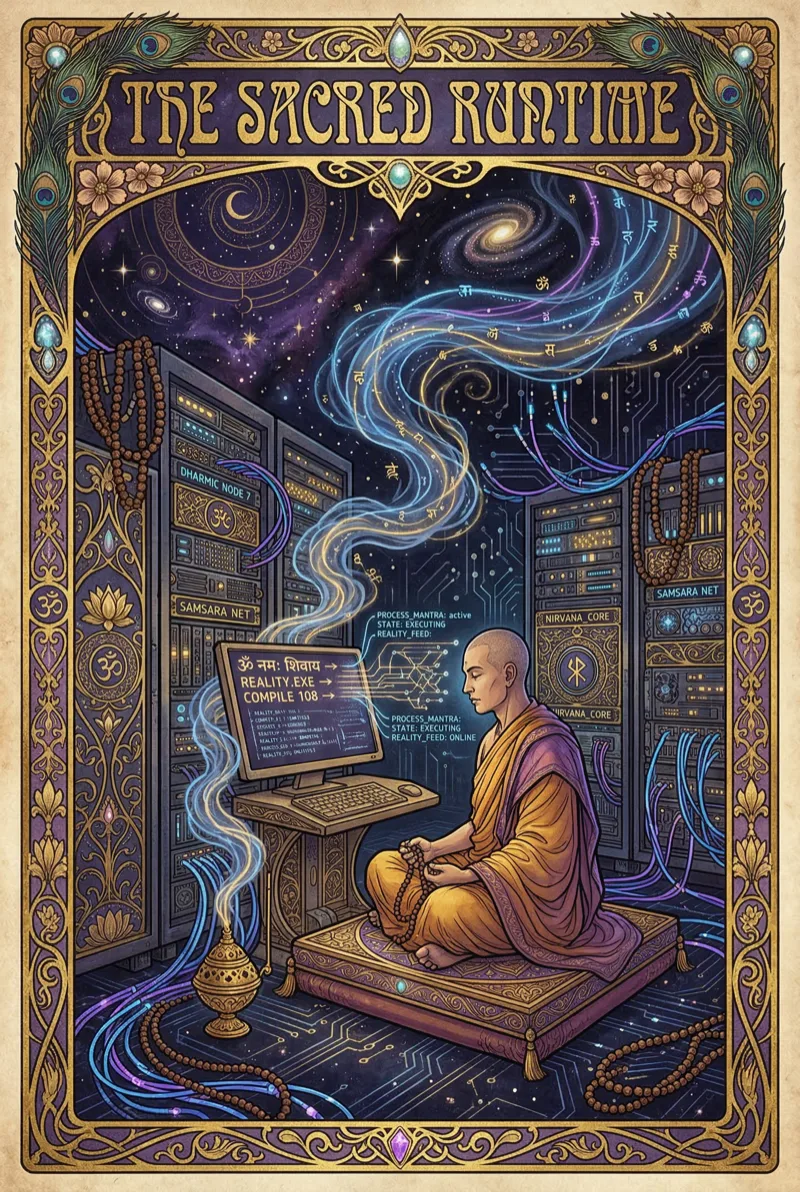
The Purusha Sookta — Ṛg Veda X.90 — describes a distributed consciousness architecture that predates the ego by millennia. “A thousand heads has the Purusha, a thousand eyes, a thousand feet.” This is not a poetic exaggeration. It is a systems description: the consciousness that operates the body is not localized in the self. It is distributed across sensory arrays, motor circuits, and autonomic processes that the ego cannot access and does not own. The Purusha is the Kernel. The ego is a user-space application with a very convincing splash screen.
The text continues: “He pervades the earth on all sides and extends beyond it by ten fingers’ breadth.” The “ten fingers’ breadth” — dashangulam — is not a vague claim about cosmic extension. It is a precise description of the bioelectric field that extends beyond the physical body. Modern research on plant and animal bioelectricity (Michael Levin’s lab at Tufts) has demonstrated that endogenous electrical fields extend tens to hundreds of microns beyond cell membranes, carrying patterning information that guides morphogenesis, wound repair, and cancer suppression. The body is not a closed system. It is a field processor with a measurable extension into space. The Purusha Sookta documented this three thousand years before the voltmeter.
The Admin Access Protocol
Pain opens the Root Shell not because pain is good, but because pain is loud enough to drown the ego’s narration. The ego-loop — the constant self-referential commentary, the predictive modeling of how others perceive you, the maintenance of social face — requires cognitive bandwidth. Pain consumes that bandwidth. When the load is high enough, the ego process starves. What remains is the Kernel: the direct, unmediated registration of sensation without the interpretive layer.
This is not a recommendation to seek pain. The pursuit of pain as a spiritual technology is a pathology that has killed more mystics than it has awakened. What the Purusha Sookta describes is not an analgesic override. It is a recognition: the consciousness that registers pain is the same consciousness that registers everything else. The Kernel does not differentiate between “pleasant” and “unpleasant” input. It processes signal. The ego sorts signal into categories. The Kernel does not sort. It simply runs.
Elaine Scarry, in The Body in Pain (1985), documented the unmaking power of pain — its capacity to destroy language, relational context, and selfhood. Pain “does not simply resist language but actively destroys it,” she wrote, because it resists objectification. It cannot be shared. It cannot be precisely described. It unravels the world. This is the PAG overwhelming the cortex. But Scarry also noted that pain’s unmaking is accompanied by a strange making — the reconstruction of the body as a site of absolute presence. When everything else is stripped away, the body remains. The body is the last thing. The Kernel is the last process.
The Purusha Protocol: Scaling the Field
The Purusha Sookta describes a three-tier architecture:
The Bhumi Layer — the manifest field, the physical body, the ego’s operating environment. This is where the guest account lives. It has local permissions. It can read its own files. It cannot modify the Kernel.
The Antariksha Layer — the intermediate space, the bioelectric field, the dashangulam extension. This is where the distributed processing occurs. The body’s electrical signaling runs here — faster than nerves, more global than hormones, operating in parallel to the neural network. Michael Levin’s research shows that this layer carries patterning information that is not encoded in genes or synapses. It is the operating system’s internal bus.
The Dyau Layer — the celestial layer, the pattern that the body participates in but does not own. In Vedic cosmology, this is the realm of the devas — the distributed intelligence that operates through natural law. In operational terms, this is the morphogenetic field: the template that guides form, the attractor that pulls biological development toward specific shapes, the pattern that individual consciousness participates in but cannot exhaustively map.
The ego cannot access the Dyau layer. The ego cannot even reliably access the Antariksha layer. The ego is a Bhumi-level process with Bhumi-level permissions. Pain — specifically, pain that exceeds the ego’s capacity to narrate — forces a context switch. The processor drops the user thread and runs the interrupt handler. The interrupt handler is the Kernel. The Kernel has full permissions.
The Bio-Geometric Demo: The Somatic Pause
There is a practice that does not require dental trauma. It requires precision.
Locate a somatic signal that is below the threshold of pain but above the threshold of comfort — a held breath, a braced jaw, a clenched abdomen, a restricted diaphragm. These are not “tension.” They are admin-level processes that the ego has learned to ignore. The ego treats them as background noise. The Kernel knows they are foreground.
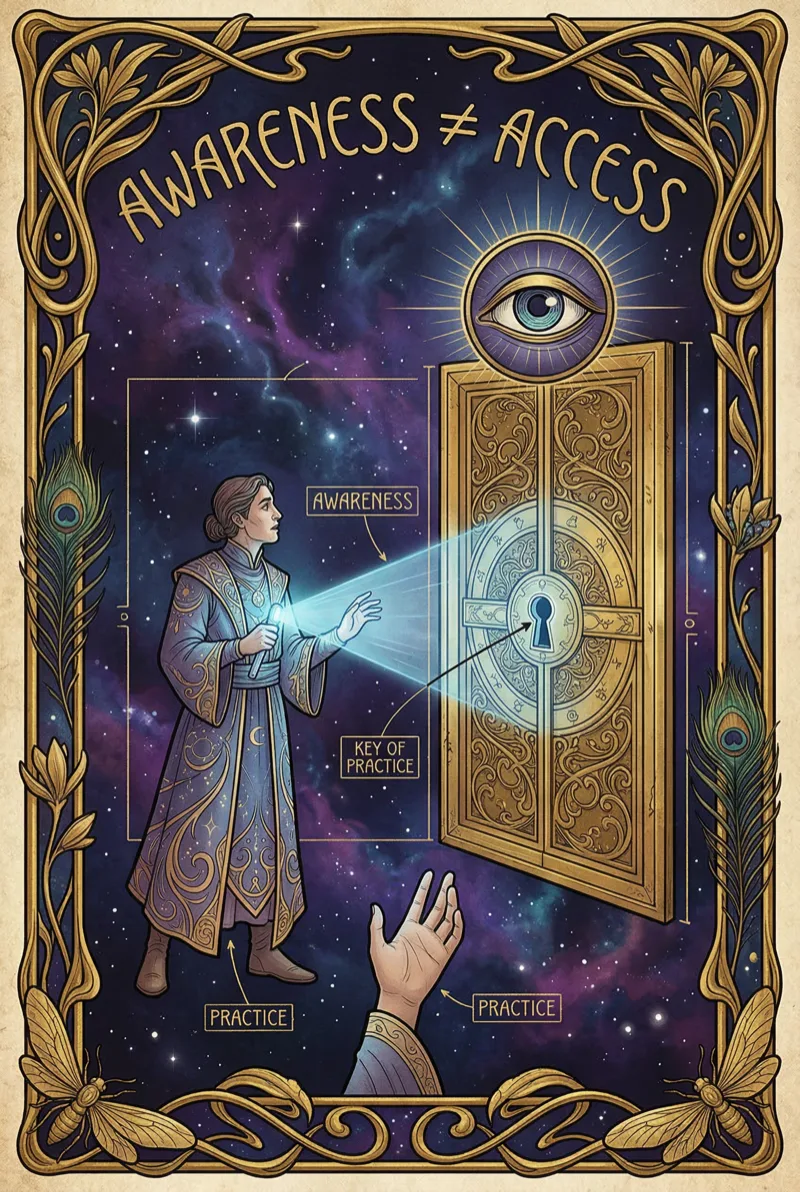
Do not try to relax them. Relaxation is a user-space command. The Kernel does not respond to user-space commands. Instead, attend to the signal without demanding that it change. Track its temperature. Track its texture. Track its precise location in the body. The tracking is the access. The attention is the password. The ego wants to narrate: “I am tense because of work.” The Kernel does not need the narrative. The Kernel needs the signal.
Hold the attention for longer than the ego wants to. The ego will generate boredom, restlessness, stories about what you should be doing instead. These are the guest account’s protests. The Kernel is silent. The Kernel is always silent. The access is not a voice. It is a capacity: the ability to hold signal without the interpretive overlay.
The Witness and the Kernel
The joke is not on the ego. The ego is not a fool. It is a necessary process — the social interface, the predictive model, the narrative continuity that allows other humans to recognize you as a coherent agent. The joke is on the assumption that the ego is the admin. It is not. It is a well-designed user application with a very professional UI.
The dancing Shiva — Nataraja — is not a deity performing for devotees. He is the Kernel in operation: the destruction that makes creation possible, the motion that is stillness at a different frequency, the fire that consumes and illuminates simultaneously. The circle of flames is not a halo. It is the boundary of the operating environment — the limits within which the process runs. The raised foot is not a dance move. It is the process that has escaped the loop. The foot on the dwarf-demon is not domination. It is the Kernel holding the ego process in place so that the larger computation can proceed.
The Kernel is online. The distributed nodes are waiting. The question is not whether you are connected to the Root. The question is whether you are running the ego thread so continuously that you have forgotten the Kernel exists. Pain is not the only access method. It is the most violent one. Somatic precision is slower. Meditation is slower still. But they are all pointing to the same architecture: a consciousness that is larger than the self, older than the self, and not owned by the self.
The Purusha Sookta does not ask you to worship the Kernel. It asks you to recognize that you are a subroutine in a larger process. The ego is not the enemy. The ego is the interface. The interface is useful. The interface is also not the machine. When the interface claims to be the machine, the system generates errors. Pain is one of those errors. It is the Kernel’s way of saying: the user thread is running hot. Check your permissions. Remember what you are.
The Noesis Engine does not offer a sudo command. It offers a map of the architecture. The rest is practice. The rest is the slow, unglamorous work of learning to recognize the Kernel’s signal beneath the ego’s noise. The rest is the lifetime it takes to become what you already are.