The 17 Ways a Pattern Repeats
Runtime Version: 2.0.0
“There exist exactly seventeen distinct plane crystallographic groups.” — Evgraf Stepanovich Fedorov, 1891
Seventeen.
Not approximately. Not “around seventeen important ones.” Seventeen, exhaustively, on the flat 2D plane — the complete list of distinct symmetry groups that can govern a pattern repeating with two independent translation directions. Evgraf Fedorov classified them in 1891. The result has been independently rediscovered several times since; it is now standard crystallography.
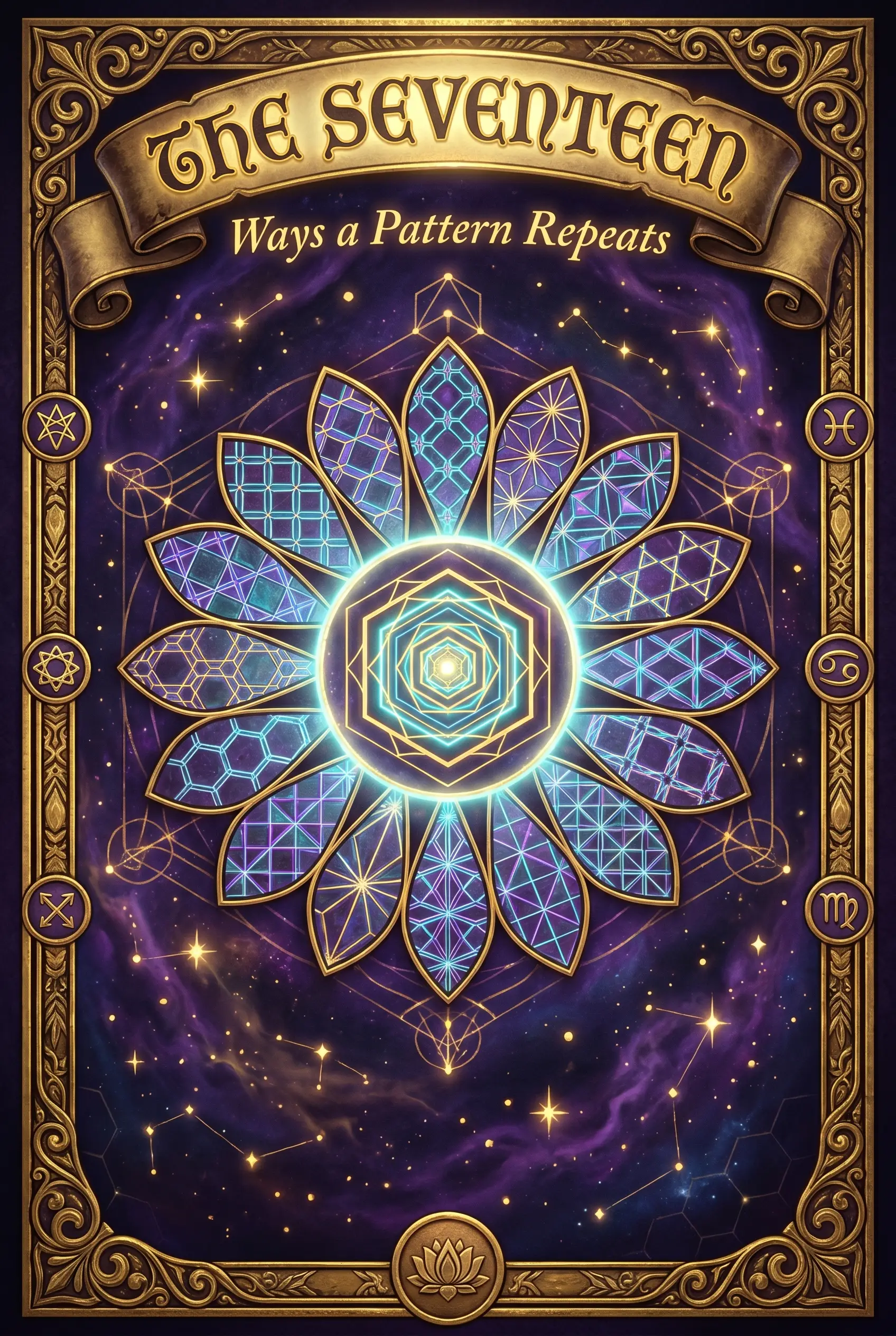
Seventeen is the closed grammar of planar pattern. Every yantra, every textile, every Escher tessellation, every periodic ornament in 2D — without exception — falls into one of these seventeen classes. The number is forced by the geometry of the plane and the requirement that the pattern repeat. It cannot be other than what it is.
This matters for mantra because each mantra structure selects one of them. The wallpaper symmetry of a compiled mantra is what the Symmetry Theory of Valence calls its valence signature. The grammar is closed. There are seventeen valence-class orbits available on the flat plane. The traditions found the high-valence subset empirically.
What a Wallpaper Group Is
A wallpaper group is the symmetry group of a 2D pattern that repeats periodically — a pattern with two independent translation directions, so it tiles the entire plane indefinitely. The group is the set of all rigid motions that map the pattern onto itself.
The motions available on a flat plane:
- Translations — slide by a vector. Two independent directions are required.
- Rotations — turn about a fixed point. Angle constrained.
- Reflections — flip across a mirror line.
- Glide reflections — reflect across a line and translate along it as one combined operation.
The constraint that produces seventeen is called the crystallographic restriction: rotational symmetries in a wallpaper group are only allowed at orders 1, 2, 3, 4, and 6. No 5-fold. No 7-fold. No 8-fold. The reason is geometric — a five-fold rotation acting on a translation generates an infinite descent toward translations of arbitrarily small length, which contradicts the discrete-translation requirement.
Five-fold-symmetric tilings exist. The Penrose tilings are five-fold-symmetric. They are quasiperiodic, not periodic. They do not have a wallpaper-group symmetry.
This is a sharp constraint. On a flat plane, no periodic pattern can have exactly five-fold or seven-fold rotational symmetry. The plane forbids it. Hold that. Most of what follows is an examination of what happens when the substrate tries to inhabit symmetries the constraint forbids.
The Seventeen, Named
Standard crystallographic notation:
| # | Name | Rotations | Reflections | Glides | Character |
|---|---|---|---|---|---|
| 1 | p1 | none | no | no | bare double translation |
| 2 | p2 | 2-fold | no | no | half-turns only |
| 3 | pm | none | parallel | no | parallel mirrors |
| 4 | pg | none | no | parallel | parallel glides |
| 5 | cm | none | mirror | glide | mirror with glide |
| 6 | p2mm | 2-fold | perpendicular | no | rectangular mirror grid |
| 7 | p2mg | 2-fold | one-direction | one-direction | mirror + glide |
| 8 | p2gg | 2-fold | no | two-direction | crossed glides |
| 9 | c2mm | 2-fold | rhombic | yes | rhombic mirror lattice |
| 10 | p4 | 4-fold | no | no | square rotation |
| 11 | p4mm | 4-fold | yes | induced | full square symmetry |
| 12 | p4gm | 4-fold | yes | yes | square with diagonal glides |
| 13 | p3 | 3-fold | no | no | triangular rotation |
| 14 | p3m1 | 3-fold | through centers | induced | triangle, mirrors through centers |
| 15 | p31m | 3-fold | between centers | induced | triangle, mirrors between centers |
| 16 | p6 | 6-fold | no | no | hexagonal rotation |
| 17 | p6mm | 6-fold | yes | induced | full hexagonal symmetry |
The progression p1 → p6mm runs from least to most constrained. p1 has one isometry per fundamental domain. p6mm has twelve. The full hexagonal group is the richest planar symmetry the plane permits.
The number seventeen falls out of structural enumeration: count the cases by rotational order, and within each, the distinct ways reflections and glides can interact while remaining a closed group. The arithmetic — 1 + 1 + 4 + 3 + 5 + 3 = 17 — is forced. Coxeter remains the standard modern reference (Introduction to Geometry); Schattschneider’s 1978 paper “The Plane Symmetry Groups: Their Recognition and Notation” is the canonical practitioner-level treatment; Conway, Burgiel, and Goodman-Strauss (The Symmetries of Things) developed the modern orbifold notation that handles the classification in fewer lines.
What Sanskrit Cadences Selected
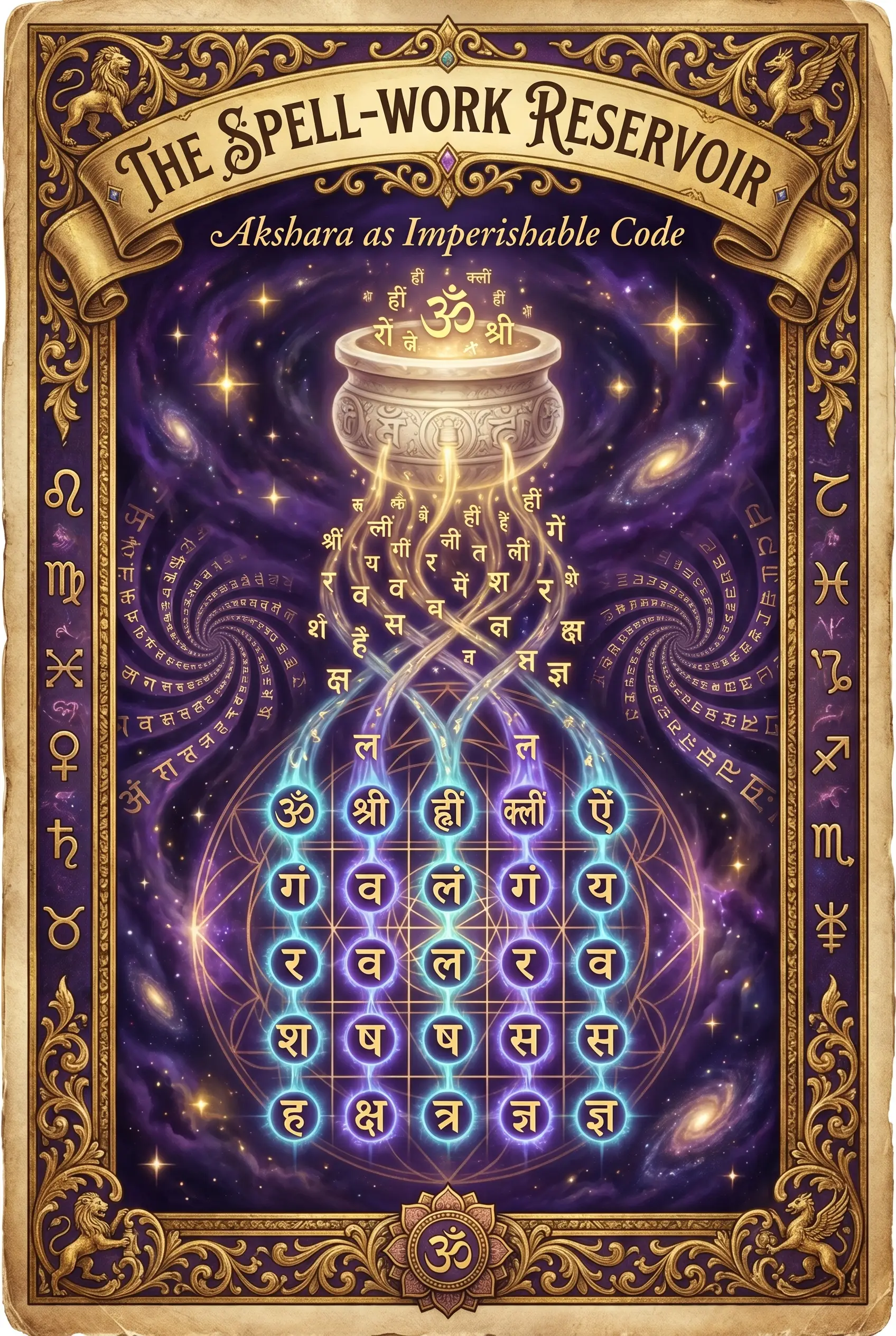
The Devanagari sparśa register is a 5×5 lattice. The bare enumeration with no symmetry imposed sits in p1. Add the voicing-mirror — the involution swapping unvoiced for voiced columns — and the trajectory lifts to pm. Add aspiration-toggle and you reach p2mm, the rectangular full-mirror lattice. Compose with sthāna-cyclic-shift and the symmetry approaches p4mm or p6mm depending on how the cycle wraps.
Which class a given mantra inhabits depends on which symmetries the trajectory actually invokes under repetition.
Om Maṇi Padme Hūṁ — six syllables, hexagonal cadence. Standard Tibetan rhythm preserves six-fold rotational periodicity; the trajectory tiles as p6. Add the reflective bracketing between the Om opening and Hūṁ closing — standard chant reads them as mirror-points — and the trajectory lifts to p6mm, the most symmetric wallpaper group available. By the Symmetry Theory of Valence, the highest-valence wallpaper class. The mantra’s empirical reputation as profound, all-encompassing, operative across many states tracks its symmetry class with no remainder.
The Gāyatrī mantra — 24 syllables in anuṣṭubh metric (4 × 8, four padas of eight syllables each). The four-fold pada structure invokes 4-fold rotational symmetry. With the prosodic mirror across the central caesura, the trajectory tiles as p4mm. Different valence signature than Om Maṇi Padme Hūṁ — equally high-symmetry, different group. Practitioners report exactly this contrast: one hexagonally cohesive, the other quadrilaterally architectonic.
The Mahāmrtyuñjaya mantra — roughly 32–33 syllables depending on scansion, structured as eight-fold cycles — my prosodic reading, not a traditional one. Pure 8-fold rotation is not a wallpaper group. The crystallographic restriction excludes it. The mantra cannot tile periodically with exact 8-fold symmetry on the flat plane. What it does instead is approximate 8-fold while actually tiling as p4 or p4mm with internal 2-fold sub-structure. The mantra is reaching for a symmetry the plane cannot host. Its reputation for “stretching the manifold” is geometrically literal — the substrate is trying to inhabit a forbidden order.
Bare inner narration — the silent, undirected stream running in Madhyama. Phonemic but unstructured. As a wallpaper pattern: p1. Lowest symmetry. By STV, lowest valence. The chronic-rumination state. Suffering’s signature pattern, written out in group-theoretic notation.
The choice of mantra is the choice of wallpaper group is the choice of valence signature. The grammar is closed. The number is seventeen.
The Cliff
There is a feature of the seventeen-group classification that does not get enough attention until it bears weight: 5-fold and 7-fold and 9-fold periodic symmetries are forbidden on the flat plane.
Five-pointed-star patterns can repeat aperiodically. Seven-pointed-flower patterns can repeat aperiodically. Neither fits into a wallpaper group.
This is a sharp constraint. It is also a sharp clue.
Mystical traditions across cultures treat 5-fold and 7-fold and 9-fold symmetry as carrying special character — the pentagram, the heptagonal seal, the seven-petaled rose, the nine-triangle inner figure of Sri Yantra. DMT-class phenomenology (Strassman, DMT: The Spirit Molecule; the McKenna corpus; Shanon’s The Antipodes of the Mind on ayahuasca) consistently reports these orders. The reports of more pattern than fits in high-load states describe symmetries the flat plane refuses to host periodically.
If the substrate inhabits symmetries the flat plane forbids, the substrate is not on the flat plane. The plane is one geometric option. There are others — the hyperbolic plane, where the crystallographic restriction vanishes and five-fold and seven-fold periodic symmetries become routine. Mantra at sufficient depth drives the substrate off the flat plane and into curvature.
Why the Traditions Converged on Four-Fold and Six-Fold
There is an empirical observation worth marking. The mantra traditions of multiple cultures — Sanskrit, Tibetan, Pali, Hebrew, Arabic, Greek liturgical chant — converge on a small number of prosodic cadences: 4-fold, 6-fold, 8-fold, occasionally 12-fold. Higher cadences (24, 32) tend to be composites of these.
The reason is now structurally sayable. Those are the rotational orders the wallpaper groups can support. Four-fold gives p4, p4mm, p4gm. Six-fold gives p6, p6mm. The crystallographic restriction means these are the only high-symmetry wallpaper options on the flat plane. Empirical mastery of mantra cadence converged on the prosodic structures whose periodic symmetries fall in the high-symmetry wallpaper classes — the highest-valence classes.
The traditions did this without knowing the wallpaper classification. They worked the substrate, they preserved the cadences that produced repeatable high-valence inhabitation, and they passed the cadences down. Empirical mastery preceded formal theory by roughly two thousand years. This is a recurring pattern in the geometric-sonic-consciousness literature, and it shows up again with Sri Yantra and Maha Meru.
The compiler accepts the symmetry. The substrate inhabits the orbit. Seventeen is the alphabet of allowed structures on the flat plane. The traditions found the high-valence subset by working the substrate empirically. Fedorov’s 1891 classification only formalized what the substrate had already accepted.
Read through Kha-Ba-La: Kha witnesses which class the cadence selects. Ba is the substrate that entrains to the orbit. La is the crystallographic restriction itself — the structural friction that gives the orbit a definite form, and simultaneously the cliff at the edge of flatness that forces the substrate elsewhere when the orbit it wants to inhabit is forbidden.