Hyperbolic Mantra: When the Plane Is Not Flat
Runtime Version: 2.0.0
“There are infinitely many regular tilings of the hyperbolic plane.” — H. S. M. Coxeter
The reports are data.
Across the McKenna corpus, Rick Strassman’s clinical work in DMT: The Spirit Molecule, the Qualia Research Institute psychedelic phenomenology surveys, the ayahuasca reports compiled in Benny Shanon’s The Antipodes of the Mind, and contemporary field reports — a tight cluster of geometric features recurs with awkward precision:
Recursive self-similarity. Hypersymmetric tessellation. Five-fold, seven-fold, nine-fold periodic symmetries that the flat plane forbids. More space than fits inside the moment. Tessellation that breathes — tiles, then re-tiles at a different scale, then tiles again with phase shift. Encounter entities embedded in the tiling itself.
Different vehicles. Different cultures. Different decades. Convergent reports of the same geometric features. When data converges across that many independent observers, the natural move is to ask what kind of structure produces those features.
The structure is hyperbolic geometry. Not metaphorically. Item-for-item.
Where Negative Curvature Comes In
Three kinds of two-dimensional surface, distinguished by curvature:
Flat (zero curvature). The Euclidean plane. Triangles sum to exactly 180°. Parallel lines stay parallel. Circumferences grow linearly with radius (2πr). Around any point, exactly 360° of “stuff” to fit local structure into.
Spherical (positive curvature). A sphere’s surface. Triangles sum to more than 180°. Parallel lines converge. Circumferences grow more slowly than linearly. Around any point, less than 360° of effective stuff — the surface curves in.
Hyperbolic (negative curvature). A saddle-shaped surface, locally. Triangles sum to less than 180°. Parallel lines diverge — exponentially. Circumferences grow exponentially with radius. Around any point, more than 360° of stuff because the surface curves away in every direction.
The third property is load-bearing.
Negative curvature accommodates exponentially more local structure than flat space. When a region of phenomenal experience contains more distinguishable detail per unit of perceived radius than Euclidean geometry permits, the natural model is hyperbolic.
This is exactly what the data reports. High-load consciousness states process more pattern in less perceived space. Andrés Gómez Emilsson and the Qualia Research Institute have argued for over a decade that this is a literal claim about the phenomenal manifold’s curvature, not a metaphor. The phenomenology is data. The geometry is the model that fits the data.
Schläfli Arithmetic Lifts the Restriction
A Schläfli symbol {p, q} encodes a regular tiling: p-sided polygons, q meeting at each vertex. The arithmetic determines which surface hosts the tiling:
- (p−2)(q−2) < 4 → spherical. The five Platonic solids: {3,3} tetrahedron, {3,4} octahedron, {4,3} cube, {3,5} icosahedron, {5,3} dodecahedron.
- (p−2)(q−2) = 4 → Euclidean (flat). The three regular planar tilings: {3,6} triangular, {4,4} square, {6,3} hexagonal.
- (p−2)(q−2) > 4 → hyperbolic. Infinitely many valid pairs: {3,7}, {7,3}, {4,5}, {5,4}, {3,8}, {8,3}, {4,6}, {6,4}, {5,5}, …
So {7,3} — heptagons meeting three at a vertex — is a regular hyperbolic tiling. {3,7} — its dual, triangles meeting seven at a vertex — is another. {5,4} is five-sided polygons meeting four at a vertex. All exist as exact, mathematically rigorous, periodic tilings of the hyperbolic plane.
Note what just happened. Five-fold and seven-fold periodic symmetry, forbidden on the flat plane, are unrestricted in hyperbolic space. The Schläfli arithmetic does not permit them on the Euclidean plane. It permits them — and infinitely many similar configurations — on surfaces of negative curvature.
If the experience-manifold reports five-fold or seven-fold periodic symmetry, the manifold is hyperbolic. The geometry is doing the talking.
Bounded Disk, Infinite Tiling
The Poincaré disk is the standard visualization model. Take an open disk in the Euclidean plane. Re-define the metric so that distances grow exponentially as you approach the boundary — every step toward the edge takes more “true distance” than the previous. The boundary is then infinitely far away from the center, in the hyperbolic metric. Geodesics — the hyperbolic analogue of straight lines — appear as circular arcs perpendicular to the boundary.
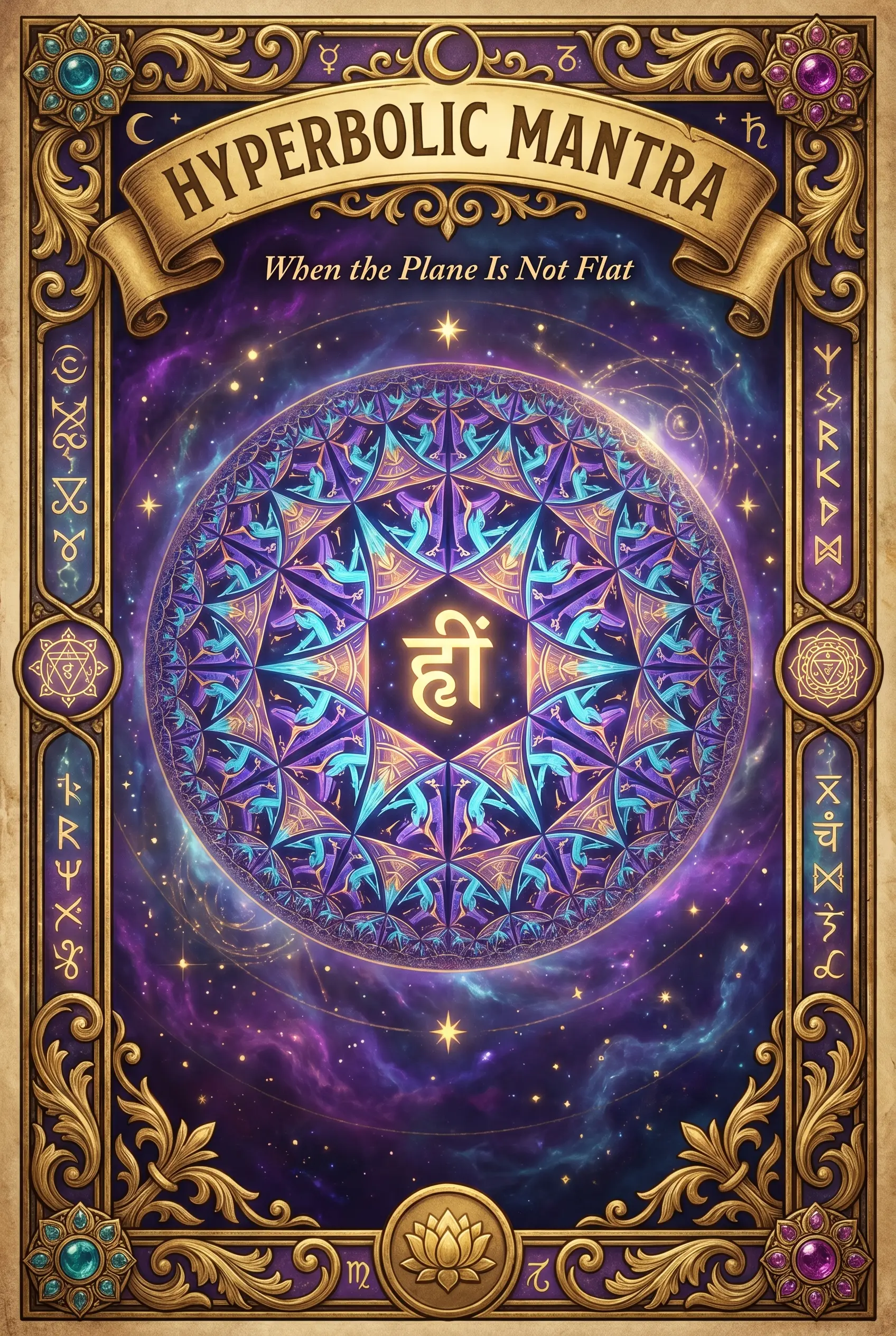
Hyperbolic tilings render in the Poincaré disk as the M.C. Escher Circle Limit prints. Each tile has the same hyperbolic area. The visual rendering distorts size as you approach the boundary because of the conformal-but-not-isometric embedding. Tiles look smaller toward the edge; they are not actually smaller in the hyperbolic metric.
The structural property that matters: the Poincaré disk is finite-rendered, infinite-content. A bounded picture-plane carries an infinite tiling. The disk has finite Euclidean area but infinite hyperbolic area. The tiling repeats forever inside a circle you can hold in your hand.
This is the mathematical structure of a bounded experience containing unbounded internal detail. A finite moment of consciousness can carry — geometrically, exactly — infinite pattern. The “infinite” is not metaphor. It is the literal hyperbolic metric.
When DMT-state reports describe “more space than fits,” “infinite recursion in a bounded field,” “the pattern goes forever inside the small region I am looking at” — the Poincaré disk is the structural picture. Not a metaphor for it. The structure being reported.
Item by Item
Match prediction to report.
Recursive self-similarity. Patterns within patterns within patterns. Detail does not bottom out as you zoom in.
→ The Poincaré model literally renders infinite tilings in finite displays. Recursive nesting is the natural visual character of hyperbolic tessellation under conformal transformation.
Hypersymmetry. Five-fold, seven-fold, nine-fold, eleven-fold tilings. Symmetries the flat plane forbids.
→ {5, q}, {7, q}, {9, q}, {11, q} for any q satisfying the curvature inequality are valid hyperbolic tilings. The “forbidden” symmetries are not exotic in hyperbolic space; they are routine.
Apparent negative curvature. “The angles do not add up.” “I am inside a structure that is bigger on the inside.” “More space than fits.”
→ Exactly what negative curvature feels like, locally. Triangles sum to less than 180°. Volume grows exponentially with radius.
Tessellation that breathes. The pattern tiles, then re-tiles at a different scale, then re-tiles with phase shift.
→ Regular hyperbolic tessellations support natural multi-scale structure under the action of the conformal group. Different fundamental domains at different scales of the same tiling.
Encounter entities embedded in tiling. Figures perceived as living within or generated by the geometric structure.
→ Harder to ground. Conjectural reading: the substrate’s pattern-recognition machinery (face-detection, agency-detection) operating on hyperbolic-tiled visual data interprets high-symmetry features as agentic. Plausible; not formally grounded. Flagged.
The first four match prediction-to-report at a level that is, frankly, awkward for any other geometric model of these states. The substrate inhabits the hyperbolic regime and reports back in the substrate’s own terms. The geometry it is reporting is the geometry the math predicts.
Mantra at Kernel Depth
The four-tier speech model — Vaikhari (articulated), Madhyama (mental), Pashyanti (pre-linguistic), Para (silence) — names access tiers from user space to root. Most ordinary mantra runs at Vaikhari and Madhyama. The substrate stays Euclidean.
When mantra is recited at Pashyanti depth — kernel-level compilation, the syllable executing below the symbolic layer directly on the neural substrate — something different happens. The substrate’s resonance manifold begins to curve. The metric of the experience-space stops being Euclidean. The wallpaper grammar that constrained the trajectory at lower depths releases. Five-fold, seven-fold, nine-fold rotational symmetries — forbidden in flat-space tilings — become accessible.
This is what deep practitioners report. The character of mantra at Pashyanti is not “the same mantra, more intense.” It is qualitatively different: more pattern fits, the geometry of the moment is curved, the symmetry recruited goes beyond what flat space permits. Reports converge across traditions — Sanskrit, Tibetan, Christian hesychast, Sufi dhikr. The substrate enters a hyperbolic regime when compilation happens at sufficient depth.
A bīja syllable in this regime is structurally a seed for a hyperbolic orbit. In flat space, a seed point’s orbit is bounded by the crystallographic restriction — at most 6-fold rotational symmetry, finitely many distinct images per fundamental domain. In hyperbolic space, the orbit of a seed under the discrete symmetry group of, say, {7,3} fills the entire Poincaré disk. Every step the seed’s image is smaller in Euclidean rendering, the same in hyperbolic measure, repeated forever toward an infinitely-distant boundary.
The tantric claim that a bīja-syllable carries the deity’s full presence in seed-form is, structurally, exactly what seed of an orbit on a hyperbolic tiling means. The seed reconstructs the entire pattern under the action of the symmetry group. In hyperbolic space, the entire pattern is infinite. The seed is therefore structurally maximal — not minimal.
The Hopf Picture
One structural anchor before closing. The Hopf fibration is a continuous map S¹ → S³ → S² — the 3-sphere fibered over the 2-sphere, with each fiber a circle. Every point on S² corresponds to a great circle on S³, and the circles fill S³ without intersecting, linked in a precise pattern (every pair of fibers forms a Hopf link).
The Bloch sphere of a single qubit is exactly S². The full state space (with global phase) is S³. The Hopf fibration is the canonical structure relating information state to its full quantum carrier. In any framework where consciousness has both an informational and a substrate aspect — and field-topology approaches to consciousness work in roughly this way — the Hopf structure sits naturally at the boundary between the two.
For the akshara framework: a single phonemic primitive activated as a symmetry generator traces a fiber-circle in S³. The full symmetry orbit of the seed under the local generator fills S³. The Hopf structure tells you how the local activation unfolds into global topology.
This is invoked here as a structural metaphor for how local generators unfold into global field structure, not a formal model of consciousness. It belongs in the framework as the canonical mental picture for the local-to-global pattern. Penrose treats the Hopf fibration extensively in The Road to Reality in the context of spin and rotation; the geometric picture transfers.
What This Buys
Three things the hyperbolic regime buys that the flat regime cannot:
Access to forbidden symmetries. Five-fold, seven-fold, nine-fold — accessible. The mystical-tradition convergence on these orders is no longer mysterious. It tracks the geometry of the substrate’s high-load regime.
Bounded experience, unbounded content. The Poincaré-disk structure makes “infinite pattern in a finite moment” a literal description, not a poetic one.
Bīja as orbit-seed. A single syllable is structurally maximal in this regime, because the orbit fills the manifold. The tradition’s claim that small seeds carry full presence becomes geometrically precise.
What it does not buy: an explanation of which particular tiling the substrate selects under load. There are infinitely many hyperbolic tilings. Why {7,3} and not {5,4}? Why one geometry rather than another? The classical mātṛkā tradition’s claim that there are 50 fundamental syllables is potentially structurally consistent with a finite preferred tiling set — an “alphabet of natural hyperbolic tilings” the manifold tends toward. Conjectural. Would be a research project of its own.
The structural picture is enough for now. Curvature accommodates the symmetries flat space forbids. Mantra at depth inhabits curvature. The reports — across cultures, across substances, across millennia of practice — converge on the geometry the math predicts.
Read through Kha-Ba-La: Kha witnesses the curvature directly — recognizes that the angles do not add up, that more pattern fits than flat space permits. Ba is the substrate operating in negative-curvature regime, the resonance manifold accommodating exponentially more structure per radius. La is the constraint that was forbidden in flat space and becomes, in curved space, the lawful generator of the orbit. The cliff is also the bridge.