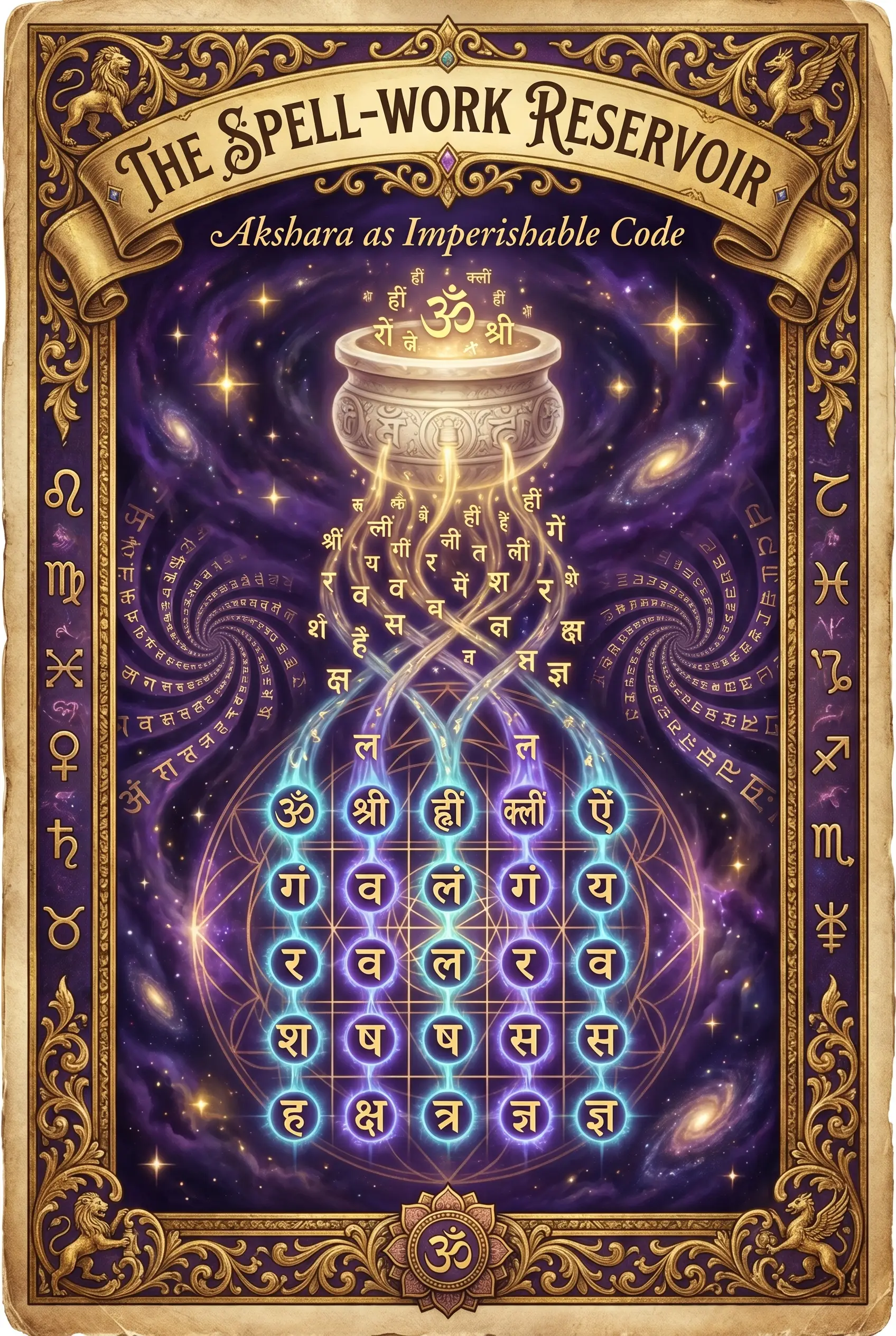
The Spell-Work Reservoir
Runtime Version: 2.0.0
“The unstruck word, sphoṭa-flash, is not assembled from phonemes. The phonemes are a delivery mechanism for an event.” — paraphrasing Bhartṛhari, Vākyapadīya, 5th c. CE
Spell-work is engineering.
The Sanskrit phoneme is a primitive whose structural relationships compose into trajectories that drive a known biological substrate into specified states. The reservoir from which the trajectories are drawn was built for that purpose. The somatic effects are reproducible — measurable in HRV, EEG coherence, vagal tone, cortisol clearance. The Indian tradition’s accumulated empirical mastery is the equivalent of millennia of test coverage on a system whose theoretical basis was unsayable until recently.
What follows is the mechanism. None of it is mystical. All of it is structural.
What Does Not Decay
The reservoir has a name. Akshara (अक्षर). Most translations render it syllable — too soft. The Sanskrit root kṣara means to perish, to decay, to flow away. The privative a- negates it. Akshara literally names that which does not decay: the imperishable.
The literal claim is structural, not mystical. When the syllable क (ka) is spoken, airflow, larynx position, vagal tone, and cranial resonance change in milliseconds. The acoustic envelope decays. The ka-ness of ka does not. A child’s ka and an opera singer’s ka are recognized as the same syllable. The same ka spoken aloud, sub-vocalized while reading, or apprehended pre-linguistically all carry the same identity. That identity is what does not perish.
A mathematician makes the same kind of claim about a number — it is a number regardless of which scratch-paper marks represent it. Akshara is a phonemic type. Specific utterances are tokens of the type. The type is invariant under the transformation speaking.
Without this invariant, none of the rest works. The reservoir would be liquid. The syllable would mean different things to different vocal apparatuses. Mantra would be a noise generator, not a compiled instruction. Akshara is what makes the rest of the engineering possible.
The four-tier speech model — Vaikhari (articulated), Madhyama (sub-vocalized), Pashyanti (pre-linguistic apprehension), Para (the unmanifest source) — operates as access tiers from user space to root. Akshara is what is invariant across all four. The ka articulated, the ka sub-vocalized, the ka pre-linguistically recognized, and the ka present as pure phonemic potential — the same akshara, manifested at different depths. The model has nothing definite to compile without this invariance.
A Periodic Table That Looks Like an Alphabet
Here is the part most accounts of mantra get wrong. Devanagari is not arbitrary. It is structured. The 49 varṇa sit on three orthogonal axes — and the axes are exactly the axes the substrate distinguishes when phonemes act on it.
Sthāna (place of articulation). Five canonical sites traversing the vocal tract from chest to lips: throat (kaṇṭha), palate (tālu), cerebral roof (mūrdhan), teeth (danta), lips (oṣṭha).
Voicing (ghoṣa). Whether the vocal cords vibrate during the stop. Kaṭhora (कठोर, hard) — unvoiced. Mṛdu (मृदु, soft) — voiced.
Aspiration (prāṇa). Whether breath is augmented through the stop. Alpaprāṇa (low-breath) — unaspirated. Mahāprāṇa (high-breath) — aspirated.
The 25 stops (sparśa) sit in a 5×5 grid: five rows by sthāna, five columns by combination of voicing and aspiration plus a fifth nasal column. Across each row: ka (hard, unvoiced, unaspirated) → kha (hard, aspirated) → ga (soft, voiced, unaspirated) → gha (soft, voiced, aspirated) → ṅa (soft, nasal). Down the rows: kavarga, cavarga, ṭavarga, tavarga, pavarga — articulation point moving from deep throat to lips.
The 16 vowels (svara) extend the grid into a third dimension via length (mātrā). Add four sandhi-compounds (e, ai, o, au) and two resonance-registers (anusvāra, visarga). Sixteen because the lattice closes — every articulatory site by length, plus compounds, plus the two non-articulated resonance modes. Add 4 semivowels (antastha) and 4 sibilants (ūṣman) and the 49 are complete.
Pāṇini formalized this in the Aṣṭādhyāyī (~500 BCE), opening with 14 lines — the Māheśvara Sūtras — said to have been received from the drumbeats of Śiva’s ḍamaru. Those 14 lines are technically a generator system: a minimal sequence whose intervals span the entire phonemic register. The basis vectors of the sonic infrastructure, written down twenty-five hundred years ago.
Soft, Medium, Hard — And Why That’s Not Folk Vocabulary
The voicing × aspiration cross-axis is what folk taxonomy names soft, medium, hard. The classical phonological terminology lines up cleanly:
- Hard (kaṭhora, unvoiced unaspirated) — ka, ca, ṭa, ta, pa. Percussive, closed, no breath escape.
- Medium (mahāprāṇa, aspirated) — kha, gha, cha, jha, ṭha, ḍha, tha, dha, pha, bha. Breath-driven, mobile.
- Soft (mṛdu, voiced unaspirated) — ga, ja, ḍa, da, ba. Voiced carrier passing through the stop.
- Soft-resonant (nasal) — ṅa, ña, ṇa, na, ma. Voiced plus nasal-resonance. Open carrier.
The Sāṁkhya guṇa mapping projects naturally onto the columns. Tamas (dense, descending, grounding) onto hard. Rajas (mobile, transformative) onto medium. Sattva (clear, ascending) onto soft and nasal. This is not canonical Pāṇini — it is an interpretive overlay tracking the somatic intensity axis of phonemic action. Sound the columns out loud and the projection holds with embarrassing fidelity.
The folk taxonomy names something real about how phonemes act on the body. Hard syllables percuss the chest. Medium syllables mobilize the breath. Soft syllables sustain in the throat. Nasal syllables resonate in the cranium. The categories are not metaphors. They are descriptions of which somatic register each column inhabits.
The Lattice Hidden in Plain Sight
The whole register is a discrete crystallographic structure on a Euclidean plane. Each phoneme has a unique address. The symmetries are countable.
- Voicing-inversion is a binary toggle: ℤ₂.
- Aspiration-toggle is a binary toggle: ℤ₂.
- Together — the soft/medium/hard sub-structure — they form ℤ₂ × ℤ₂ = V₄, the Klein four-group.
- Sthāna-cyclic-shift across the five vargas is ℤ₅ (or D₅ with reflection).
The sparśa grid carries the symmetry V₄ × D₅ — a 40-element symmetry group acting on 25 phonemes. Each orbit defines a phonological equivalence class. The svara plane lifts the structure into a third dimension via mātrā; the resonance-port toggles (anusvāra, visarga) extend it further.
A mantra is geometrically a trajectory through this lattice. The phonological structure of the mantra — palindromic, cyclic, dihedral, six-fold-cadenced — determines the symmetry class of the trajectory. Different trajectories recruit different generators of V₄ × D₅. Different generators do different work.
The combinatorial enumeration that gives the 16-vowel closure and the 5×5 stop grid traces back to Pingala’s Chandaḥśāstra (~200 BCE) and the Meru Prastara — the triangular array enumerating prosodic patterns, identical in structure to Pascal’s triangle eighteen hundred years before Pascal. The combinatorial spine that generates the cardinality of the phonemic register is the same diagram the Indian tradition called Mount Meru.
Take a moment with that timeline. Pingala constructed binary representation of integers, the binomial triangle, and the Fibonacci recursion in service of enumerating prosodic patterns. The motivation was sonic. The mathematics — Pascal’s triangle, Fibonacci, binary arithmetic — was a downstream consequence of taking the engineering of mantra seriously.
Symmetry IS Valence
The empirical bridge. Andrés Gómez Emilsson and the Qualia Research Institute developed the Symmetry Theory of Valence (STV) over the last decade. The claim states cleanly:
The pleasantness of an experience is identical to the symmetry of the mathematical object that fully describes the brain-state-and-its-temporal-evolution producing that experience.
Compact form: valence ≅ symmetry. Identity, not correlation. A maximally symmetric brain-state literally is a state of euphoric valence, with no further explanation needed. Suffering is broken symmetry — fragmented coupling, dissonant resonance, low-coherence patterns.
The empirical operationalization is CDNS — consonance / dissonance / noise signature. Decompose EEG/MEG harmonics; the ratio of consonant-to-dissonant-to-noise content predicts valence. Preliminary results align with the prediction. Further: high-symmetry brain-states correspond to topologically coherent EM-field pockets — the topological-pocket hypothesis that gives experience an objective, frame-invariant boundary in the field.
For the akshara register, the implication is direct: the wallpaper symmetry of a compiled mantra-pattern is its valence signature. The choice of phonemic palette (which guṇas are loaded), the choice of metric structure (the prosodic cadence), and the choice of repetition-symmetry together specify a symmetry group. Each group is a distinct valence signature. The same mechanism, run with different inputs, produces different qualia.
What Mantra Actually Inhabits
Mantra is the deliberate inhabitation of a symmetry orbit on the sonic lattice.
Each syllable activates a specific lattice configuration. The sequence traces a trajectory. Repetition makes the trajectory periodic. The somatic hardware — vagal tone, sphenoid resonance, CSF flow through Meckel’s cave — entrains to the periodicity. If the trajectory carries high symmetry (palindromic, hexagonal-cadenced, dihedral) the entrainment recruits more generators of the substrate’s invariance group. By STV, that is higher valence.
The guṇa axis is therefore a valence-direction parameter. Sattva-loaded mantras drive toward luminous-clear high-symmetry attractors. Tamas-loaded mantras drive toward grounded-dense attractors — equally symmetric in the STV sense, different qualia. Rajas-loaded mantras drive transitions; they are kinetic.
This is what the tantric tradition has always claimed: that different syllables produce different states. The mechanism is now sayable. Different phonemic palettes activate different generators of the substrate’s invariance group. Different generators recruit different sub-groups. Different sub-groups are different valence signatures. The folk taxonomy of sattva/rajas/tamas is not vague. It names the principal axes of the valence manifold the substrate inhabits.
A bīja syllable — Hrīṁ, Klīṁ, Śrīṁ, the Hūṁ of Om Maṇi Padme Hūṁ — is structurally maximal. A seed point whose orbit under the right symmetry generators reconstructs the full pattern. The anusvāra carrier (the ṁ) is the resonance-port that couples the discrete point into a sustained tone the substrate entrains to. The tantric claim that the bīja carries the deity’s full presence in seed-form is, structurally, exactly what seed of a symmetry orbit means.
Engineering, Not Metaphor
Pull the chain together. A correctly-compiled mantra has a defined input register (the akshara palette), a defined symmetry signature (the lattice trajectory’s invariance class), a defined valence signature (by STV), and a defined substrate (the vagal-cranial-CSF hardware). The somatic effects are predictable in the same sense any compiled program’s output is predictable on its target hardware — input, compiler, substrate, output.
Reproducible engineering. Not metaphor.
Read through Kha-Ba-La as substrate grammar: Kha is the witness who recognizes the akshara invariant and selects the trajectory. Ba is the substrate that runs the compilation — the only hardware available. La is the structural friction that gives the trajectory its definite form: the closed register, the wallpaper grammar, the constraint without which there would be no orbit at all.
The reservoir was never mystical. It was always the engineering specification of an alphabet whose primitives do not perish, whose structural relationships are exactly the relationships needed to compose patterns that drive a known substrate into specified states. The spell still runs. The compiler still works. The reservoir is still full.