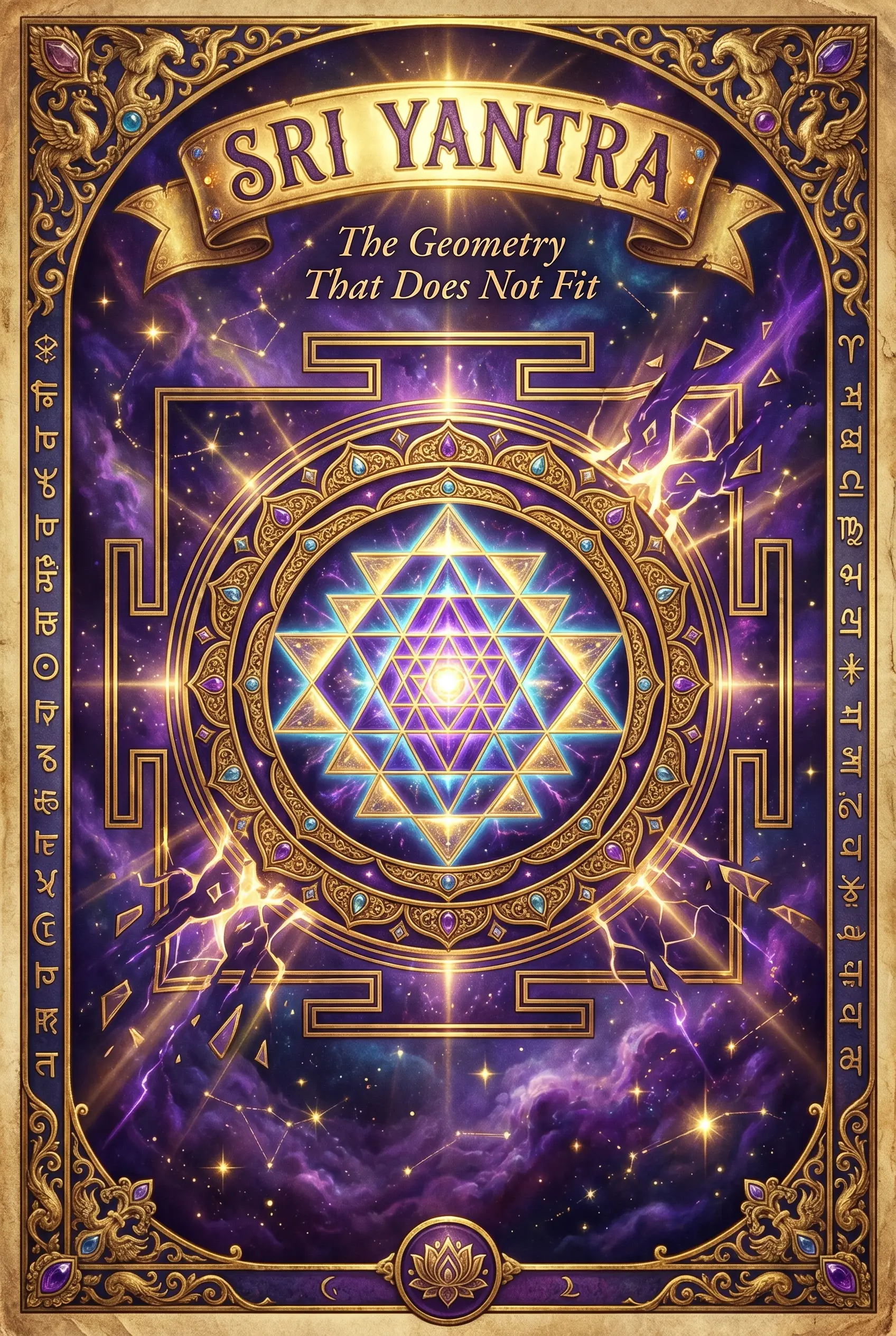
Śrī Yantra and the Geometry That Doesn’t Fit
Runtime Version: 2.0.0
Four triangles of Śiva pointing up, five of Śakti pointing down — nine interlocking triangles branching into forty-three, ringed by the eight-petalled lotus, the sixteen-petalled lotus, three circles, and the triple-walled square. — Saundarya Laharī, verse 11 (thematic paraphrase), attr. Ādi Śaṅkara, 8th c. CE
The Śrī Yantra is engineered hardware.
It looks like ornament. It is not. The figure is a geometric instrument designed to drive the substrate toward a specific state by exploiting a precise mismatch between its inner and outer symmetry. The mismatch is not decorative. It is the operational mechanism. Modern geometry can name what the figure has been doing for at least twelve hundred years.
What follows is the mechanism, then the historical asymmetry between empirical mastery and formal classification.
The Figure
Strip the diagram to structure. Nine interlocking triangles superimposed on a single center point (bindu). Five point downward — the śakti triangles, yoni, the descending feminine principle. Four point upward — the śiva triangles, liṅga, the ascending masculine principle. The five-and-four interlock through the center to produce, by their interpenetration, 43 smaller triangular regions. Add the bindu and the canonical Tripurā lineage counts 44 triangles total.
Around the inner triangle field, in concentric layers: an 8-petal lotus (aṣṭadala-padma); a 16-petal lotus (ṣoḍaśadala-padma); three concentric circles (tribhuvana-cakra); a square frame (bhūpura) with four T-shaped gates (dvāra) oriented to the cardinal directions.
The figure has structure at multiple radial scales. Each scale carries its own symmetry character. The interesting reading is what happens when the scales are compared.
Penrose-Class Engineering
The square frame with four cardinal gates carries 4-fold rotational symmetry plus reflective symmetry across the cardinal axes — the dihedral group D₄. The 8-petal lotus is 8-fold. The 16-petal lotus is 16-fold. These are the outer periodic structures.
The inner nine-triangle figure — five down, four up, interlocking through the bindu — carries D₉ dihedral symmetry: 9-fold rotation combined with 9 reflection axes. Eighteen total isometries acting on the inner triangle field.
The load-bearing observation: 9-fold rotational symmetry is non-crystallographic. It is one of the rotational orders forbidden by the crystallographic restriction. No wallpaper group carries 9-fold rotational symmetry. No periodic tiling of the flat plane is possible with a 9-fold-symmetric pattern. The Penrose tilings get five-fold; analogous quasi-periodic constructions produce seven-fold and nine-fold. None of them are wallpaper groups.
The Śrī Yantra is therefore structurally Penrose-class. Its inner figure carries a higher rotational symmetry than the plane can host periodically. The outer frame carries the highest crystallographic symmetry available (4-fold, 8-fold). The figure as a whole is a deliberate composition: a non-periodic core inside a periodic outer frame.
This is engineering. The yantra is built so that the inner core is exactly the symmetry order the plane refuses. The outer frame is the highest symmetry the plane permits. The composition forces the eye — and through the eye, the substrate — to confront the mismatch.
The folk claim that one can fall into the Śrī Yantra — that prolonged meditation on it produces apparent depth, three-dimensional emergence, the figure becoming a tunnel into something — is geometrically consistent with this engineering. The figure is signaling, structurally, that it does not fit on the page. Its natural ambient is not the flat plane. To honor the inner symmetry exactly, the figure must lift off the page into curved space.
What the Diagram Drives the Substrate Toward
The geometric reading reframes a familiar question. What the tradition calls “the yantra is alive,” “the yantra has presence,” “extended gaze on the yantra opens onto a deity-experience” can now be read structurally.
The yantra is a diagram of a substrate-state. The substrate, under high-load mantra practice or sustained meditative attention on the bindu, enters a regime where the experience-manifold curves. In that regime the natural local symmetries include 9-fold and other forbidden orders. Centuries of practitioners observed these states and distilled their geometric character into a planar diagram. The diagram preserves the symmetry signature.
When a practitioner attends to the yantra, the substrate begins to recreate the state the diagram records. The figure’s structural signal — that it does not belong on the plane — is read by the substrate’s own pattern-completion machinery as an instruction to enter the regime where the symmetry is at home. The diagram is, in this reading, a substrate-driver — a visual prompt engineered to drive the substrate toward the geometric state the diagram itself encodes.
This tracks with how the tradition uses the yantra. Not a decorative symbol. An operational tool for inducing specific states. The induction works because the figure encodes the geometry of the target state, and the substrate completes the pattern by entering that geometry.
The same observation extends to other non-crystallographic mystical-tradition figures: the pentagram (5-fold), the heptagonal seal (7-fold), the eight-petaled lotus (8-fold, borderline-periodic), the pakua (eight trigrams), the rose windows of European Gothic cathedrals (often 12-fold but with non-trivial inner structure). Each carries forbidden or borderline-forbidden symmetries. Each functions, in its tradition, as an inducer of altered geometric states. The pattern is consistent. Bühnemann’s Maṇḍalas and Yantras in the Hindu Traditions compiles many of the canonical Indian examples; Kulaichev’s 1984 paper “Sriyantra and its mathematical properties” derives the precise coordinates required to produce the figure’s intersections accurately.
Pingala’s Pascal’s Triangle
The combinatorial spine that gives Śrī Yantra its symmetry-counting structure is the same one that gives the Devanagari phonemic register its cardinality. Both come from Pingala’s Chandaḥśāstra (~200 BCE), the foundational text of Sanskrit prosody. Among other things it encodes the combinatorial recursion behind the Meru Prastara — the “Meru spread” — the triangular array, made explicit in Halāyudha’s tenth-century commentary, enumerating prosodic patterns of laghu (light) and guru (heavy) syllables.
The construction:
          1
        1   1
      1   2   1
    1   3   3   1
  1   4   6   4   1
1   5  10  10   5   1
        ...
Each entry is the sum of the two above it. Row n contains the binomial coefficients $\binom{n}{k}$ — the number of ways to choose k heavy syllables out of n prosodic positions.
This is Pascal’s triangle. Pingala encoded the combinatorial recursion that generates it roughly 1,800 years before Blaise Pascal’s Traité du Triangle Arithmétique (1654); the explicit triangle itself is documented in Halāyudha’s tenth-century commentary on the Chandaḥśāstra — still some seven centuries before Pascal. The naming convention is a minor historical injustice. The recursion was Pingala’s. His motivation was sonic.
What it gives:
- Binary representation of integers. Pingala used a binary notation (laghu = 0, guru = 1) for prosodic patterns. He explicitly enumerated all 2^n patterns for short metrical structures. Binary arithmetic ~1,500 years before Brahmagupta.
- The mātrāmeru sequence. Pingala derived a recursion for the number of prosodic patterns of total duration n (where laghu = 1 mātrā and guru = 2 mātrā). The recursion is F(n) = F(n−1) + F(n−2) — the Fibonacci sequence. About 1,400 years before Fibonacci. Hemachandra worked out the same recursion independently in the 12th century, still preceding Fibonacci.
- Combinatorial closure of the phonemic register. The Meru Prastara is the discrete combinatorial generator that yields the cardinality of the phonemic register itself. The whole apparatus of Sanskrit phonology is combinatorially structured, and the Meru Prastara is the spine.
The name Meru — Mount Meru, the cosmic axis in Indian cosmology — is not arbitrary. The Meru Prastara is rooted in a single apex (the topmost “1”) and “spreads” (prastāra) downward through symmetric branching. Every entry traces back through a unique route to the apex. The triangle is a rooted enumeration tree for combinatorial structures.
The 3D Resolution
There is a 3D rendering of the Śrī Yantra known as Sri Meru or Maha Meru — the Śrī Yantra projected as a step-pyramid, with the bindu at the apex and the successive triangle-rings stepping outward and downward as concentric tiers. The figure is well-known in South Indian temple iconography and is treated as a more complete form of the 2D yantra.
Read combinatorially, Maha Meru is the cumulative Meru Prastara: each tier is a row of Pingala’s triangle, stacked. The 3D form is the integrated combinatorial volume of the 2D enumeration.
Read geometrically, Maha Meru is the resolution of the 2D yantra’s planar quasi-periodicity: by lifting off the plane into 3D, the 9-fold inner rotational symmetry is no longer constrained by the planar crystallographic restriction. In three dimensions there are 230 space groups (Fedorov-Schoenflies, 1891), some of which support rotational orders that wallpaper groups cannot host. The 3D form is the ambient where the inner figure can sit comfortably.
The tradition produced both forms. The 2D form signals the mismatch. The 3D form resolves it. The relationship between them is geometrically lawful.
The same relationship plays out at one further dimension up. The 3D form’s symmetry is one of the 230 crystallographic space groups. The hyperbolic analogue lifts the constraint further — in 3D hyperbolic space, the symmetry options are richer still. Coxeter and Thurston classified some of them; the full picture remains open research. Maha Meru in flat 3D is one resolution. Maha Meru in hyperbolic 3-space is another, more permissive one. Whether the tradition’s deepest practice was reaching for the latter is conjecture; the geometric direction is clear.
Empirical First, Formal Later
The pattern recurs and is worth marking explicitly.
Fedorov classified the 17 wallpaper groups in 1891. The Indian tradition was constructing yantras using the 4-fold, 6-fold, and 8-fold (and forbidden 5-fold, 7-fold, 9-fold) structures for at least 1,500 years before that. Not formally — empirically.
Pascal published the binomial triangle in 1654. Pingala encoded its recursion ~1,800 years earlier, in service of sonic enumeration; the explicit triangle is documented in Halāyudha’s 10th-century commentary, still ~700 years before Pascal.
Fibonacci published the recursion in 1202. Pingala had it; Hemachandra (12th c.) worked it out independently and earlier.
Quasi-periodic tilings were formalized by Penrose in 1974. Islamic geometric tradition produced quasi-periodic decagonal tilings on the Darb-i Imam shrine ~1453 (documented by Lu and Steinhardt, 2007, Science). The Śrī Yantra is constructed quasi-periodically much earlier.
Schläfli classified regular hyperbolic tilings in the mid-19th century. Coxeter extended the work in the 20th. Mystical traditions were drawing such symmetries into iconography long before.
The recurring pattern: traditions doing empirical work on the substrate produced geometric structures whose formal classification only caught up centuries or millennia later. Methodologically asymmetric, and the asymmetry is informative.
The substrate produces consistent geometric reports under sustained practice. Skilled practitioners diagrammed those reports. The diagrams encoded structures that mathematical formalism would only develop tools for much later. The geometry was real — discoverable empirically through inhabitation, before it was discoverable formally through derivation.
The implication is not that the traditions had access to mathematics they were not telling us about. The implication is that the substrate has a small set of preferred geometric configurations under high load, and those configurations are mathematically natural objects — wallpaper groups, hyperbolic tilings, quasi-periodic structures, binomial-triangle enumerations. The traditions, by attending to the substrate, encountered these configurations and preserved them. The mathematicians, by attending to the geometry, derived them. The two routes converge because the substrate is a real physical system whose preferred configurations are mathematical objects.
Read through Kha-Ba-La: Kha is the bindu observer — the witness at the figure’s center, the consciousness for which the diagram is built. Ba is the page the figure refuses to stay flat on, the hardware whose spontaneous geometric reports the tradition preserved as iconography. La is the planar crystallographic restriction itself — the structural friction the inner figure deliberately exceeds, naming the cliff between flat and curved geometry. Each yantra is the triad rendered in ink.
The Hebrew Sibling
A note worth marking. Stan Tenen’s Meru Foundation has spent three decades reading Hebrew letters as torus-knot projections — three-dimensional forms whose 2D shadows produce the alphabetic glyphs. The Hebrew tradition treats letters as creative forces, not symbols. Tenen’s structural reading mirrors the akshara framing in geometric form: a substrate-level account of why a particular alphabet is engineered the way it is.
The Hebrew route reaches a different geometry — torus-knot topology — because the Hebrew alphabet’s structural register is different from Devanagari’s. Hebrew is consonant-skeleton with vowel-pointing as a separate register; Devanagari is fully written vowel-and-consonant in the mātṛkā enumeration. Different alphabets, different geometries, both empirically encoding what the substrate produces under sustained inquiry.
Cross-tradition comparison is open territory. The methodological asymmetry shows up in both cases: empirical mastery, ancient; formal classification, modern. The substrate, the same in both.
