Why Insight Isn’t Change
A Runtime Model for Self-Authorship
Most people I know are not lacking intelligence, effort, or language.
They have read deeply. They have sat in silence. They have traced their patterns through years of observation. They can narrate their loops with precision.
And still, when pressure rises, the same loop executes.
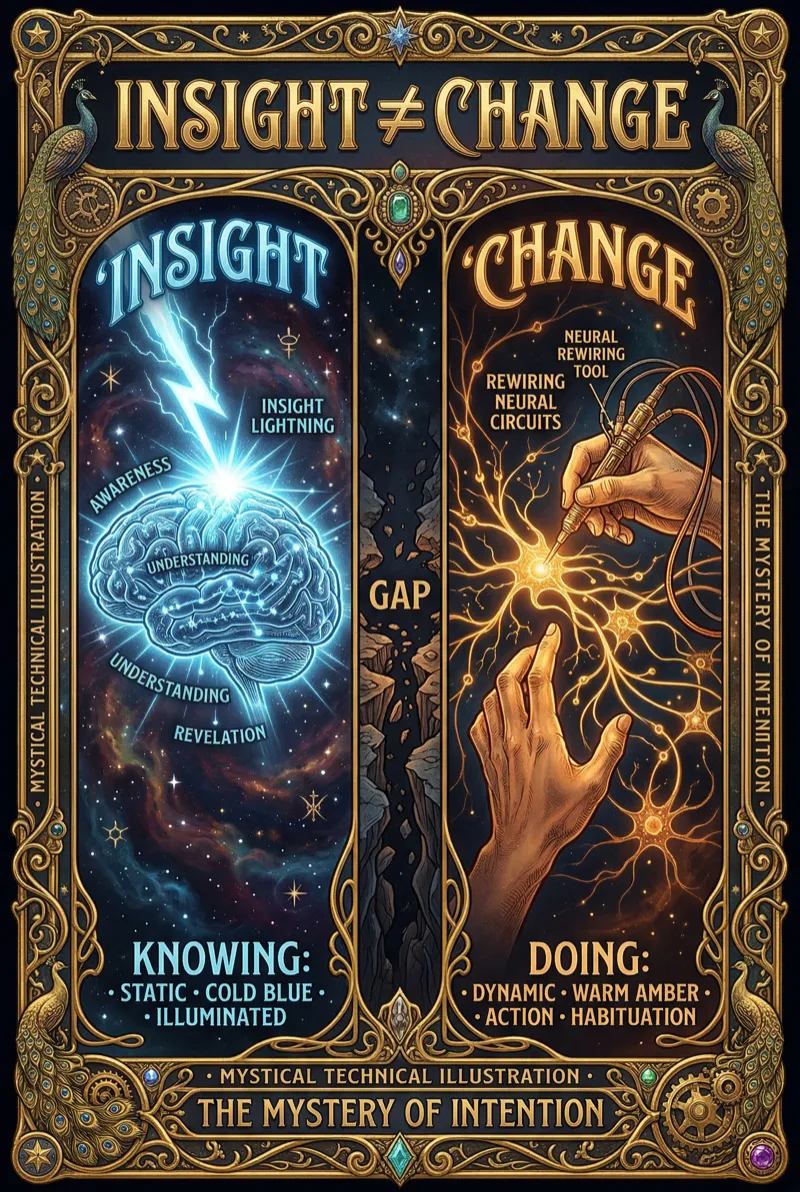
That gap—between insight and repeated execution—is where this inquiry begins.
Not with: “How do I become better?”
With: “What is running me when I’m not consciously choosing?”
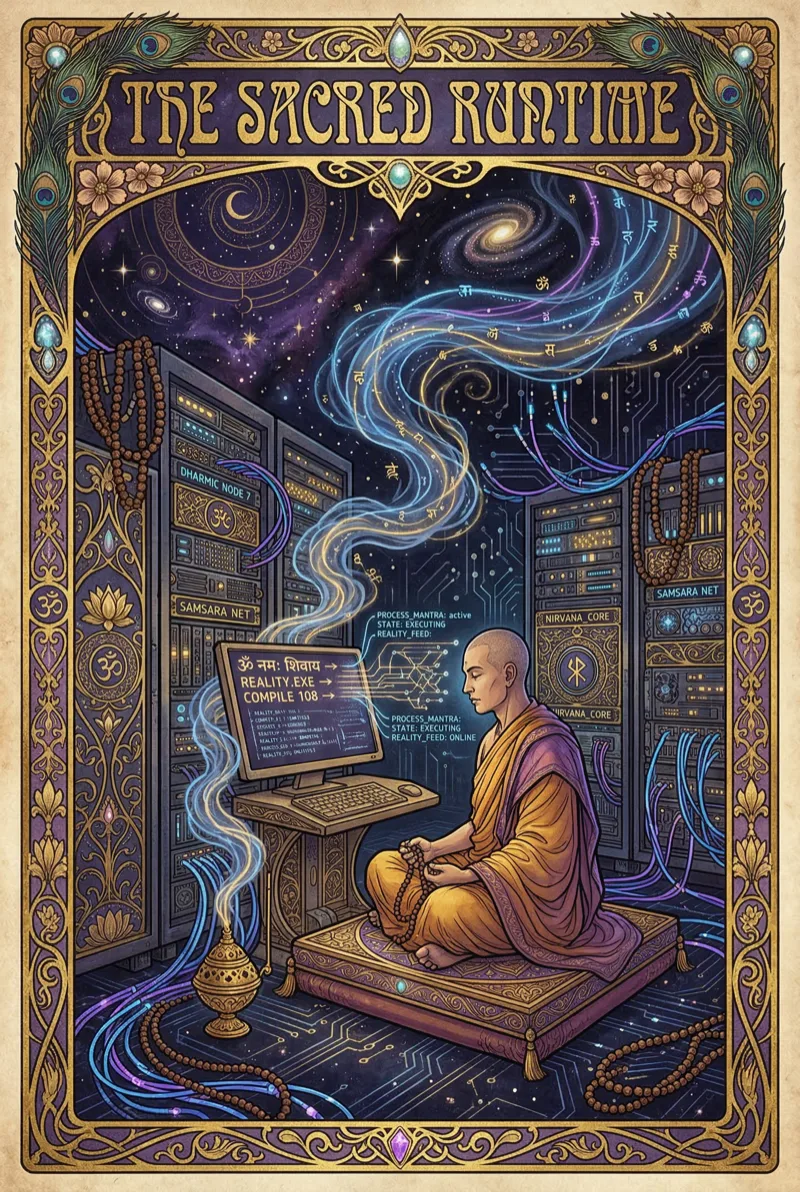
We Don’t Just Have Habits. We Have Runtime.
A habit is a behavior you can observe.
A runtime is the active architecture behind behavior.
It includes:
- attention defaults,
- threat responses,
- identity-protection scripts,
- relational reflexes,
- and narrative repairs after the fact.
You can improve visible behavior while the underlying runtime stays unchanged.
That is why people can become more articulate and still remain trapped in the same life-pattern.
Better language is not the same as deeper freedom.
The Triad as Structural Requirement, Not Decorative Map
Kha-Ba-La is not a motivational framework. It is a description of three forces that must co-arise for any pattern to actually shift.
- Kha — witness capacity. Can you see what is occurring without collapsing into it?
- Ba — embodiment. Can you act from that seeing, not just describe it?
- La — inertia. What resists change, and what stabilizes it?
These are not stages you move through. They are simultaneous conditions. When any one is absent, the work fails in a specific, predictable way.
What happens when Kha is absent
Without witness capacity, you act from the loop itself. The pattern sees through your eyes. You explain your behavior brilliantly, but the explanation is part of the loop. You become a sophisticated narrator of your own captivity. Every insight is folded back into the pattern it describes.
What happens when Ba is absent
You can see clearly and still not move. You know exactly what you are doing, and you do it anyway. The body has not been recruited. The nervous system still executes the old branch. Seeing without embodiment is a different form of paralysis—one that feels like progress because you are so articulate about it.
What happens when La is absent
You try to change everything at once. You generate intense interventions, dramatic reinventions, and then collapse. Without La, there is no form to hold the new shape. Inertia is not the enemy. It is the continuity that allows a pattern to stabilize long enough to be tested. Without it, you have only noise.
Scaling: From the Single Loop to the Recurrent Pattern
The same architecture operates at four levels. Not because it is poetic, but because it is recursive.
Personal
At the individual level, a person discovers that their “insight” into childhood patterning is itself a replay. They can explain their father’s coldness, their mother’s anxiety, their own compensatory strategies. They have built a museum of self-knowledge. But under stress, they still withdraw, attack, or freeze in the exact same geometry. The insight is a more ornate version of the same loop.
Interpersonal
In relation, the pattern doubles. One person’s default meets another’s default, and they form a circuit. You see this in couples who both “understand” their attachment styles intellectually but still enact the same pursuit-withdrawal sequence every time one partner is tired. The knowledge is there. The runtime is not.
Systemic
Institutions run on this same logic. A company can hire consultants, conduct retreats, and distribute frameworks about “psychological safety” while the actual decision-making runtime remains dominated by the same fear-avoidance structure that produced the original crisis. The framework is adopted. The execution branch is not updated.
Cosmic
At the largest scale, civilizations inherit runtime. The inherited code of a culture is not its stated values but its stress responses—what it does when resources contract, when threat rises, when the future becomes uncertain. Insight at this scale is philosophy. Change at this scale is alteration in what executes under pressure.
Metabolizing the Shadow: Cost, Fracture, Rupture, Inherited Code
Real change requires contact with what the pattern protects.
Every runtime has a cost. The Type 5-style pattern preserves distance. The tax is isolation. The Type 8-style pattern preserves control. The tax is armored tenderness. The Type 9-style pattern preserves low friction. The tax is self-erasure.
These are not flaws to eliminate. They are fractures to metabolize. The pattern was built for a reason, usually in conditions where the alternative was rupture. A child who learned to disappear to avoid conflict is not weak. They are executing inherited code that once prevented collapse.
Metabolizing this material means recognizing that the pattern is not a mistake. It is a survival architecture that has outlasted its context. The work is not self-attack. It is updating the execution branch while honoring the original logic.
A Practical Protocol
If you want change that survives contact with real life, you need a method, not a mood.
-
Name one recurring loop. One sentence. No mythology. No self-attack.
-
Identify the pre-loop signal. Where is the earliest marker? Body sensation, thought tempo, tone shift, relational impulse.
-
Install one interruption action. Keep it small, embodied, and repeatable. Not a reinvention. A branch condition change.
-
Track evidence for 7 days. What happened, what shifted, what did not. Data over story.
-
Review trend, not daily drama. You are looking for movement in execution probability, not emotional perfection.
This is less dramatic than the theater of sudden transformation.
It also works.
What This Means for Different Architectures
If you are deeply analytical, the trap is this: you can build exquisite models about transformation while postponing transformation.
If you are highly intuitive, the trap is this: you can feel accurately but still not convert insight into durable protocol.
If you are high-agency, the trap is this: you can force behavior change that bypasses the actual architecture.
In all three cases, the missing piece is the same: conscious participation at the level where the loop begins.
A Note on Voice and Content
Many people creating in this space are allergic to sounding like a pitch. For good reason.
The antidote is simple: write from observed pattern, from tested intervention, from lived consequence.
Not from borrowed certainty.
A framework is only meaningful if it increases your contact with reality.
Otherwise it is just better branding for the same loop.
Closing
You do not need to become a different person.
You need better access to the architecture that is already running.
The work is not self-rejection.
It is self-authorship.
Not fantasy control.
Not permanent certainty.
Just cleaner seeing, earlier interruption, deeper embodiment.
Over time, that becomes a different life.
Self-consciousness as technology. Body as medium. Breath as interface.