Noetic Aether and the Einsteinian Knot: Untying Physics from Metaphysics
Runtime Version: 1.0.0
“I regard consciousness as fundamental. I regard matter as derivative from consciousness. We cannot get behind consciousness.” — Max Planck
The Knot
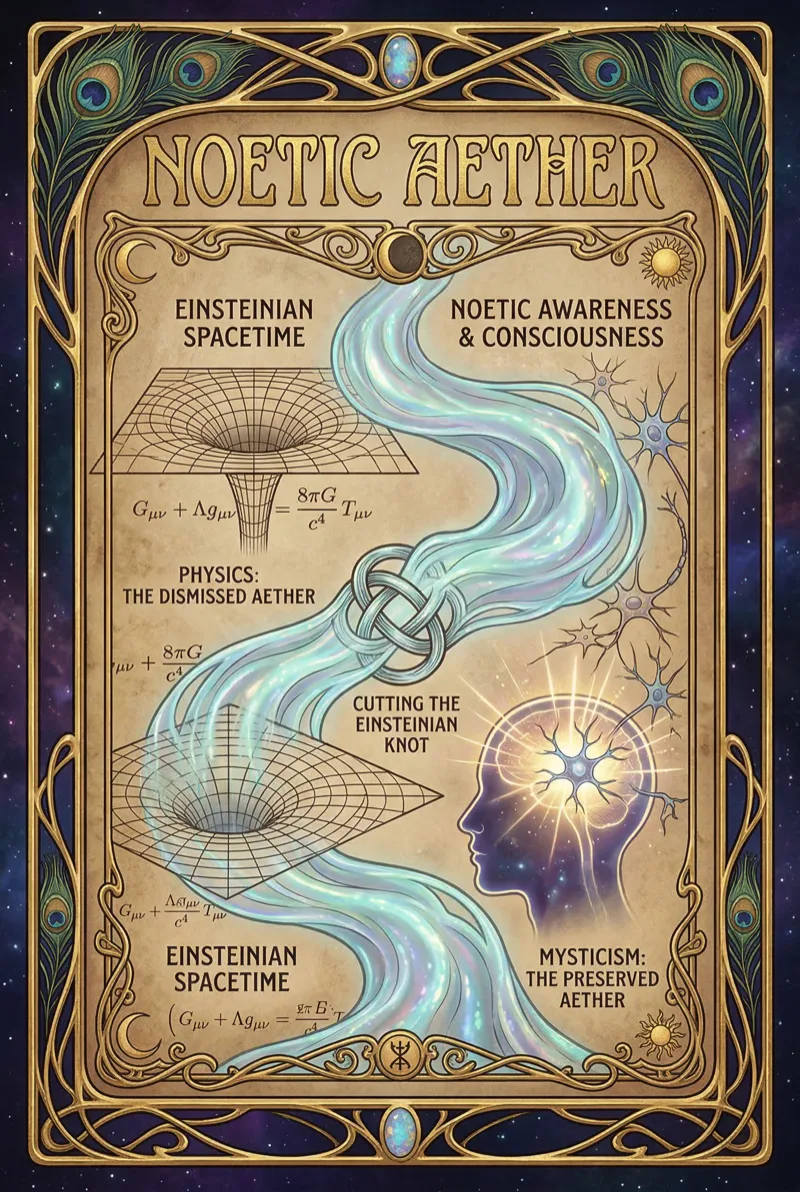
The Einsteinian knot is not a problem within physics. It is a problem between physics and metaphysics — a tangled boundary where empirical measurement and ontological interpretation are so thoroughly intertwined that pulling on one thread tightens the other.
Einstein’s special relativity produces predictions of extraordinary precision. GPS satellites, particle accelerators, and nuclear reactors all depend on relativistic corrections. The theory works. But working and being true are different properties of a theory, and the gap between them is exactly where the knot forms.
The core issue, identified by Henri Bergson in 1922 and still unresolved a century later, is the reciprocity problem. Special relativity claims that time dilation and length contraction are symmetric — each observer sees the other’s clock running slow and the other’s ruler contracted. This symmetry is required by the principle of relativity (no preferred frame). But the same effects are invoked to explain asymmetric physical results — muons surviving to ground level because their clocks run slow relative to Earth observers.
If the effects are symmetric (merely perspectival), they cannot explain asymmetric physical outcomes. If the effects are asymmetric (physically real), they violate the principle of relativity that grounds the theory. The theory oscillates between these two interpretations depending on which questions you ask. This oscillation is the knot.
The One-Way Speed Problem
The knot tightens further when you examine the theory’s foundational premise: the constancy of the speed of light. Light moves at c in all directions in all inertial frames. This seems like an empirical claim. It is not.
The one-way speed of light is fundamentally unmeasurable. Every measurement of light speed is a round-trip measurement — light goes from A to B and back to A, and we divide the total distance by the total time. To measure the one-way speed, you would need synchronized clocks at A and B. But synchronizing distant clocks requires either transporting a clock (which introduces relativistic corrections that presuppose the constancy of light speed) or sending a light signal (which requires knowing the one-way speed you are trying to measure).
Einstein himself acknowledged that the isotropy of light speed is a convention — a definition adopted for mathematical convenience, not a fact established by measurement. The entire edifice of special relativity is built on a stipulation that cannot, even in principle, be empirically verified.
This is not a reason to discard relativity. It is a reason to recognize that relativity is a mathematical framework, not a metaphysical claim. It tells us how to compute predictions. It does not tell us what reality is.
The Noetic Aether
The noetic aether theory, as developed through the work examined in this series, proposes a resolution to the Einsteinian knot by restoring the concept of an aether — but not the mechanical luminiferous aether that the Michelson-Morley experiment purportedly disproved.
The noetic aether is a field of possible interactions — a distribution of potentialities that is fundamentally nonlocal, pre-spatial, and noetic (consciousness-bearing) in character. It is not a substance through which light propagates. It is the ontological ground from which physical interactions — including light propagation — arise.
In David Bohm’s terminology, the noetic aether is the implicate order — the enfolded totality from which the explicate order (the physical world of objects and measurements) unfolds. In Whitehead’s process philosophy, it is the realm of conceptual prehension — the domain of possibilities that condition the actualization of physical events.
The critical distinction: the luminiferous aether was conceived as a physical medium within spacetime. The noetic aether is conceived as ontologically prior to spacetime. It does not occupy space because space itself is a structure within the noetic field, not a container that the noetic field inhabits.
Atoms as Organisms
The noetic aether framework radically reconceives atomic structure. Atoms are not inert particles governed by force laws. They are self-generative organisms — oscillating spherical dipoles of density (positronic core layers) and vacuity (electronic shell layers). What we call “electron orbitals” are standing wave shell structures produced by the interplay of density outflows and vacuity influxes.
This reconception resolves several persistent puzzles in atomic physics. Why do electron orbitals have specific, quantized shapes? Because they are standing waves, and standing waves have discrete modes. Why does wave-particle duality exist? Because the noetic field (wave aspect) and its localized interactions (particle aspect) are two poles of a single dipolar process — not two incompatible descriptions of the same object.
The atom-as-organism model also reframes gravity. Inertial mass is the atom’s own mass field — a density wave propagation emanating from the atomic core. Gravitational attraction between atoms is the interference pattern produced by overlapping mass fields. This is not the geometric curvature of spacetime posited by general relativity. It is field interference — a mechanism that general relativity’s mathematical formalism describes correctly but interprets metaphysically.
Light as Communication
Perhaps the most radical proposal of the noetic aether framework is its reconception of light. In conventional physics, light is an electromagnetic wave that propagates through vacuum at speed c. In the noetic framework, light is not a propagation at all — it is a communication.
Electromagnetic fields are superluminal and nonlocal — they are everywhere simultaneously, as features of the noetic aether. What we observe as “light” is a sequence of localized transmission events (photon absorptions and emissions) facilitated by these nonlocal fields. The fields do not travel; they are already present everywhere. Only the transmission events are localized in spacetime.
This resolves the double-slit paradox. The electromagnetic field passes through both slits (it is nonlocal). The photon detection events occur at specific locations on the screen (they are localized). The interference pattern emerges because the nonlocal field conditions the probabilities of localized detection events. There is no paradox because there are not two incompatible descriptions — there is one coherent framework with two aspects (field and event).
Morphic Resonance and Memory
The noetic aether framework integrates with Rupert Sheldrake’s morphic resonance hypothesis. Sheldrake’s data shows that novel synthetic crystals exhibit increasing melting points over time — each generation of crystallization is easier and more stable than the previous, as if the substance is “learning” its preferred form through accumulated morphic resonance.
In the noetic framework, this is explained naturally. The noetic field retains patterns of past actualizations. Each crystallization event adds to the noetic field’s accumulated pattern for that molecular form, making subsequent crystallizations more probable and more stable. Memory is not stored in physical structures (brains, crystals) — it exists within the past itself, and organisms tune into it through morphic resonance.
This challenges the protein folding problem at its foundations. Current computational approaches (including AlphaFold) attempt to predict protein structure from amino acid sequence alone — treating folding as a purely mechanical process determined by local energy minimization. If morphic resonance is real, then protein structure is also conditioned by the history of all previous instances of that protein’s folding — a global, temporal influence that no sequence-based algorithm can capture.
Cutting the Knot
The Einsteinian knot persists because physics abandoned metaphysics in the early twentieth century. Newton openly acknowledged that his equations described gravity without explaining it — he was a physicist who knew the limits of physics. Einstein’s framework is presented as explanatory — spacetime curvature causes gravity — but it is actually a more sophisticated description that still does not explain what gravity is.
The noetic aether framework cuts the knot by reintroducing metaphysics — not as speculation but as the necessary interpretive layer that physics has always required. Physics describes patterns in measurement. Metaphysics interprets what those patterns reveal about reality. Without metaphysics, physics is a collection of algorithms without meaning. Without physics, metaphysics is a collection of stories without constraint.
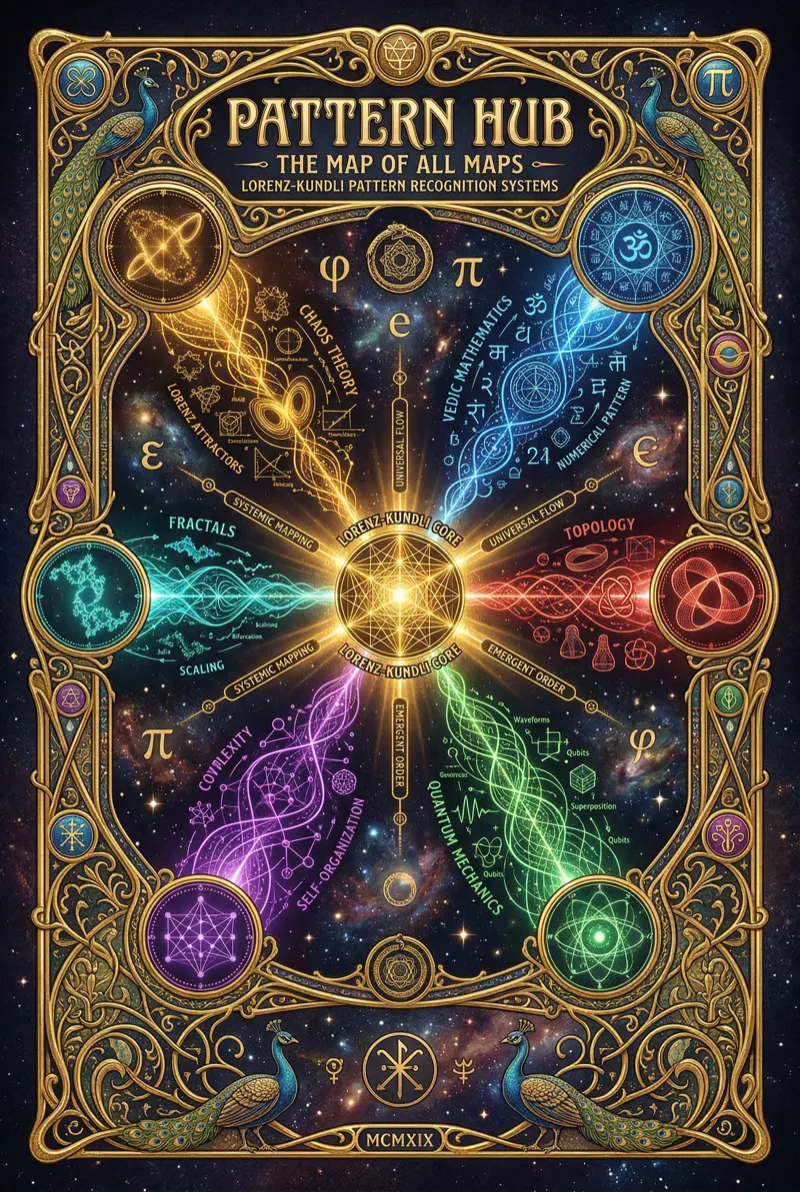
The Lorenz-Kundli pattern recognition program, across this entire series, has been an exercise in reconnecting these severed domains. Mathematical structures describe patterns. Vedic systems interpret those patterns within a consciousness framework. Neither is complete without the other. The knot is not in the physics or the metaphysics. The knot is in the artificial boundary between them. Cut the boundary and the knot dissolves.
This document is part of the Lorenz-Kundli Pattern Recognition series exploring mathematical-mystical parallels across the pattern space of consciousness.