Shadbala as Tensor Field Theory: Six-Fold Strength in Curved Space
Runtime Version: 1.0.0
“A planet’s strength is not a number. It is a vector in six-dimensional space — and vectors, unlike scalars, have direction.” — Field Coherence Manual
Six Dimensions of Planetary Strength
Most quantitative systems reduce complex phenomena to a single score. Credit scores. IQ scores. Stock prices. The Vedic Shadbala system refuses this reduction. Instead, it evaluates each planet across six independent strength dimensions, preserving the multi-dimensional nature of influence rather than collapsing it into a scalar.
The six balas (strengths) are:
- Sthana Bala — positional strength (which house and sign the planet occupies)
- Dig Bala — directional strength (alignment with the planet’s preferred direction)
- Kala Bala — temporal strength (time of day, season, planetary war considerations)
- Chesta Bala — motional strength (retrograde vs. direct, speed relative to average)
- Naisargika Bala — natural strength (inherent luminosity hierarchy: Sun > Moon > Venus > Jupiter > Mars > Mercury > Saturn)
- Drik Bala — aspectual strength (benefic vs. malefic aspects received)
class ShadbalaSystem:
    def __init__(self):
        self.strength_components = {
            'sthana': {'position_strength': 0},
            'dig': {'directional_strength': 0},
            'kala': {'temporal_strength': 0},
            'chesta': {'motional_strength': 0},
            'naisargika': {'natural_strength': 0},
            'drik': {'aspectual_strength': 0}
        }
Each component is independent. A planet can have maximum positional strength and minimum directional strength simultaneously. This independence is the defining feature of a tensor — a multi-dimensional quantity whose components transform independently under coordinate changes.
The Tensor Mapping
A tensor is a mathematical object that generalizes scalars (rank 0), vectors (rank 1), and matrices (rank 2) to arbitrary dimensions. The stress tensor in continuum mechanics describes force distributions across three spatial dimensions. The Riemann curvature tensor in general relativity describes spacetime curvature across four dimensions. The Shadbala tensor describes planetary strength across six dimensions.
class PlanetaryTensorField:
    def __init__(self):
        self.field_dimensions = 3
        self.metric_tensor = np.eye(3)

    def calculate_field_strength(self, shadbala_tensor):
        strength = np.tensordot(
            shadbala_tensor,
            self.metric_tensor,
            axes=([0, 1], [0, 1])
        )
        return strength

    def compute_field_gradient(self, shadbala_tensor):
        gradient = np.gradient(shadbala_tensor)
        return gradient
When we map the six Shadbala components into a 3x3x3 tensor (a rank-3 tensor in three-dimensional space), the diagonal elements carry the primary strengths — sthana, dig, and kala — while the off-diagonal elements carry the interaction terms — chesta, naisargika, and drik. This structure mirrors the stress-energy tensor in physics, where diagonal components represent pressures and off-diagonal components represent shear stresses.
The tensor contraction — summing over paired indices — produces the total Shadbala score, analogous to taking the trace of a matrix. But the trace loses information. The full tensor preserves the directional character of strength that the scalar total discards.
Field Gradients and Planetary Influence
In physics, a field is a quantity defined at every point in space. The gradient of a field points in the direction of maximum increase. The divergence measures whether a point is a source or sink. The curl measures rotation.
Applying these operators to the Shadbala tensor field produces a map of planetary influence that is far richer than the traditional strength score.
def analyze_planetary_field(planet_data):
    shadbala = ShadbalaSystem()
    tensor_field = PlanetaryTensorField()

    strength_tensor = shadbala.calculate_tensor_field(planet_data)
    field_strength = tensor_field.calculate_field_strength(strength_tensor)
    field_gradient = tensor_field.compute_field_gradient(strength_tensor)

    return {
        'strength_tensor': strength_tensor,
        'field_strength': field_strength,
        'field_gradient': field_gradient
    }
The gradient reveals where planetary influence is increasing most rapidly — the houses and time periods where a planet’s effect is most dynamic. A planet with a strong positive gradient is gaining influence; one with a strong negative gradient is losing it. The gradient direction tells you which strength component is driving the change. Is the planet gaining positional strength through transit? Temporal strength through seasonal shift? Aspectual strength through approaching conjunction?
Traditional Vedic astrology captures this through qualitative assessment — an experienced astrologer intuits the direction of change. The tensor formulation makes the intuition explicit and computable.
The Metric Tensor and Consciousness Geometry
In general relativity, the metric tensor defines the geometry of spacetime. It determines distances, angles, and curvature. Massive objects warp the metric tensor, bending the paths of nearby objects — this is gravity.
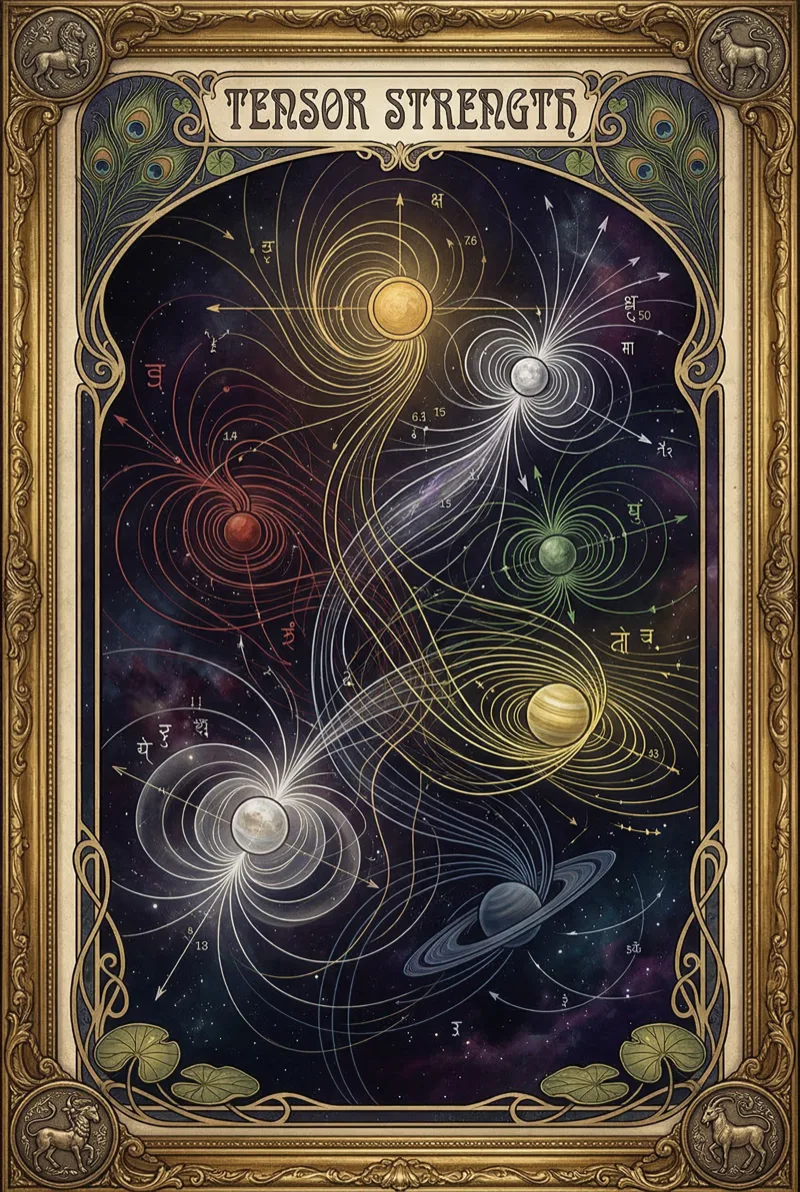
The Shadbala tensor implicitly defines a metric on the space of consciousness. Strong planets curve the experiential space around them, bending the trajectory of attention and events toward their influence. A powerful Jupiter warps the consciousness metric toward expansion, learning, and optimism. A powerful Saturn warps it toward contraction, discipline, and endurance.
The interaction terms — the off-diagonal tensor components — describe how different strength dimensions couple. Chesta bala (motional strength) couples with sthana bala (positional strength) to determine whether a retrograde planet in its own sign produces constructive or destructive interference. These couplings are not additive — they are multiplicative, producing nonlinear effects that the scalar total cannot capture.
Electromagnetic Parallels
The electromagnetic field tensor in physics is a rank-2 antisymmetric tensor that unifies electric and magnetic fields into a single mathematical object. In one reference frame, you see an electric field. In another frame, moving relative to the first, you see a magnetic field. The tensor formulation reveals that they are the same phenomenon viewed from different perspectives.
The Shadbala tensor admits a similar interpretation. Sthana bala and dig bala are the “electric” components — they describe static configuration. Chesta bala and kala bala are the “magnetic” components — they describe dynamic motion and temporal flow. Naisargika bala is the invariant — the natural strength that remains constant regardless of reference frame, analogous to the speed of light.
This unification means that apparent contradictions in chart interpretation — a planet that is positionally strong but temporally weak — are not contradictions at all. They are components of a unified tensor that only appears contradictory when projected onto lower-dimensional interpretive frameworks.
Field Coherence and System Calibration
The total Shadbala of all seven planets defines the field coherence of the chart. High total Shadbala indicates a chart where planetary influences are well-organized — the tensor field is smooth, with low curvature and minimal dissonance. Low total Shadbala indicates a turbulent field — high curvature, strong gradients, and rapid variation.
Neither is inherently better. A smooth field produces a stable, predictable life. A turbulent field produces a dynamic, transformative one. The Lorenz attractor, after all, requires turbulence to produce its characteristic butterfly pattern. The most interesting dynamics occur at the boundary between order and chaos — where the Shadbala tensor field is neither perfectly smooth nor completely turbulent.
The seers who developed Shadbala were field theorists working without the formalism of differential geometry. They computed tensor components by hand, tracked gradients through decades of observation, and identified the symmetries and invariants through contemplative practice. The mathematics they discovered is the same mathematics that Einstein needed to describe gravity. The application domain is different. The tensor algebra is identical.
Kha-Ba-La: The Tensor as Operating System
Kha (The Field) — The Shadbala tensor is not a score. It is a recognition function. Before any planet’s strength can be measured, the field must exist — the astrologer, the moment of consultation, the question that frames the chart. Without Kha, the tensor is a table of numbers. With Kha, the tensor becomes a map of forces that are currently operating. The field is not passive. It selects which components of the tensor will be visible in a given reading. A natal chart read in a moment of crisis reveals different gradients than the same chart read in a moment of calm. The field is the observer, and the observer is never neutral.
Ba (The Embodied Computation) — The tensor computes in the body of the astrologer and the body of the native. The Shadbala components are not abstract. They manifest as physiological states: Jupiter’s expansion as arterial tone, Saturn’s contraction as fascial holding, Mars’s acceleration as sympathetic tonus. The tensor is a field theory, but fields operate on bodies. The body is the substrate that gives the field its material consequence. When a transit activates a strong Shadbala component in a natal chart, the native does not experience it as a number. They experience it as a pressure in the chest, a restlessness in the limbs, a quality of attention that cannot be named. Ba is the body that hosts the computation. Without Ba, the tensor is a mathematical object with no inhabitant.
La (The Resistance) — The tensor’s nonlinearity is the resistance that makes it real. The off-diagonal components — the coupling terms between strength dimensions — are the friction that prevents the system from collapsing into simple prediction. If Shadbala were a scalar, astrology would be fortune-telling. Because it is a tensor, astrology is pattern recognition under constraint. The resistance is what makes the pattern legible. A planet with strong sthana bala but weak dig bala is not “strong” or “weak.” It is a vector with direction. The direction is the friction. The friction is the information. Remove La and the tensor collapses into a score. With La, the tensor remains a geometry of forces, and the geometry is the reading.
The three operate as a loop: Kha recognizes the field, Ba hosts the computation, La generates the resistance that makes the recognition precise. This is not a one-time calculation. This is infrastructure. The chart is recalculated every moment the field is present. The natal chart is a kernel. The transit is a process. The reading is a context switch. The Shadbala tensor is the memory map — and the memory map is alive only when the operating system is running.
This document is part of the Lorenz-Kundli Pattern Recognition series exploring mathematical-mystical parallels across the pattern space of consciousness.